

 +86 15814116500
 Views: 0 Author: Site Editor Publish Time: 2026-08-25 Origin: Site


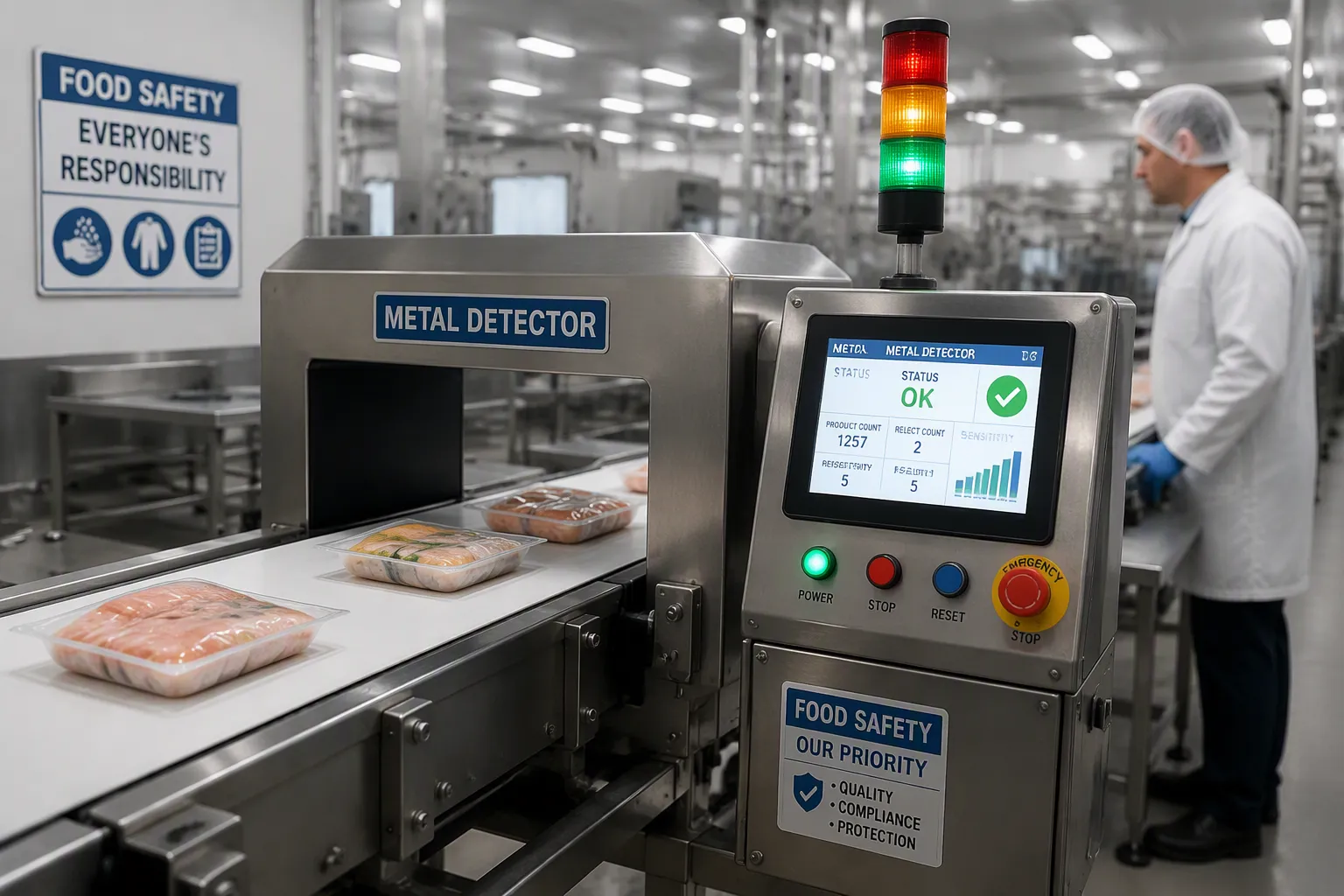
Food recalls cost companies millions. One unqualified batch can ruin your brand. You need a reliable defense against metal contamination.
What is the first step to compliance? You must understand the technology and how it fits into your HACCP plan. This safety compliance guide provides that base.
A metal detector uses electromagnetic fields to identify ferrous, non-ferrous, and stainless steel contaminants. You need this metal detection equipment to protect your food products.
COSO makes detection systems tailored for food industry needs. Their equipment supports your safety compliance guide and helps you meet regulatory standards.
This guide covers technology types, HACCP integration, validation, verification, and calibration procedures.
Table of Contents
Metal detectors use electromagnetic fields to locate ferrous, non-ferrous and stainless steel pieces.
Make metal detection a key safety step in your HACCP plan to stop contamination.
Check that your system finds metal as it should, and test it every day to make sure it still works.
Follow the FSMA, BRCGS, and SQF standards to stay compliant, with proper records and testing.
Use NIST-checked test pieces to keep your machine accurate and to test how well it works on a regular basis.
Use metal detectors to find metal pieces; use X-ray to spot glass, stone, or bone.
Test your metal detector when you start, every 30 to 60 minutes, and after any changes to keep safety reliable.
Act right away when a test fails: stop making the product, set it aside, find out why it happened, and fix the problem.
A metal detector works on a simple but strong idea. The detector head has three coils: one main transmitter coil and two receiver coils on each side. The transmitter coil sends out a radio frequency signal, which makes an electromagnetic field across the opening.
The two receiver coils are wired in opposite ways. Their signals cancel each other out, so the output is zero when no metal goes through. This balanced state changes the moment contamination enters. When a metal contaminant disturbs the electromagnetic field, the receiver coils become unbalanced. The control electronics boost this disturbance and check it against a set sensitivity limit. If the signal goes past that limit, the system triggers a detection alert.
Your metal detector must catch three types of metals. Ferrous metals have iron and react strongly to magnetic fields. Non-ferrous metals like copper and aluminum disturb the field through electrical conductivity. Stainless steel is the hardest to detect because its low conductivity gives a weaker signal. Each type needs specific calibration to ensure reliable detection.
Several factors affect how sensitive your detector can be. Product effect is the natural electromagnetic signal your food gives off. Moisture, salt, and sugar all add to this signal. A larger opening lowers sensitivity because the field spreads over a bigger area. Higher operating frequencies help find smaller particles but may cause more false rejects on certain products.
Different products need different detector designs. Your choice depends on the physical state of your food and where contamination might enter.
Conveyor systems check packaged or loose products moving along a belt. These work well for meats, cheeses, frozen foods, bakery items, and packaged convenience meals. You can adjust belt speed and detector height to match your production line. This setup works for most finished products before they ship.
Gravity-feed detectors check free-flowing dry ingredients through a vertical pipe. They use fast-acting divert valves to reject contaminants. Powders, grains, and cereals pass through these systems before production begins. Pipeline detectors handle pumped, thick products like sauces, dairy, juices, and meat pastes. Sanitary 3-way valves divert small amounts when metal appears.
Description | Typical Products | |
|---|---|---|
Gravity (free-fall) | Checks dry ingredients flowing through a vertical pipe; uses fast-acting divert valves | Powders, grains, cereals, bulk dry ingredients |
Pipeline | Checks pumped, thick products through a non-metallic pipe; uses sanitary 3-way valves | Sauces, dairy products, juices, meat pastes |
Conveyor | Checks packaged or loose products on a belt; available in multiple sizes | Meats, cheeses, frozen foods, bakery items |
Your product's traits determine which detector will work best. A food metal detector that works for dry cereal may fail on fresh meat.
Moisture content creates strong product effect signals that can hide small metal particles. Fresh meat, dairy, and fruits need advanced balancing or multi-frequency detection. Temperature changes alter moisture levels and affect coil sensitivity. Salt content adds electrical conductivity that raises false reject risk. Dense or uneven products give stronger signals that may need adjusted sensitivity settings.
Think about where contamination enters your food production. Raw ingredients may need gravity-feed inspection before processing. Finished packaged goods need conveyor systems for final checks. Your packaging material also matters. Metallic foils can hide contaminants, while glass and plastic interfere less. COSO offers detection systems made for each setup, helping you meet food safety standards and prevent foreign body contamination. Proper selection lowers contamination risk and protects your brand reputation.
Your HACCP plan keeps consumers safe from physical dangers. Metal contamination is one of the most common problems in food production. You need to decide if metal detection will be a critical control point in your process. This choice affects your whole safety compliance guide.
The FDA's HACCP Principles & Application Guidelines say that hazards in one place may not be important in another. Your hazard analysis must figure out if metal contamination is likely to happen. You cannot copy another factory's plan. You must check your own process.
Metal gets into your product in many ways. Worn out processing equipment is the top cause. Blades, grinders, and conveyors drop tiny pieces during normal use. Raw materials also bring risks. Metal tags, lead shot, hooks, staples, and wire mesh from containers often come with incoming ingredients. Poor maintenance adds more danger. Not cleaning well leaves metal shavings, cut wire, tools, and screws behind. Even human error plays a part. Broken utility knives and dropped tools put metal contaminants into your product stream.
You need to check each source's chance and seriousness. Ask yourself: How often does this equipment break? What happens if a screw falls into the product? The FDA's Compliance Policy Guide Sec. 555.425 sets a rule. Hard or sharp foreign objects bigger than 7 mm in ready-to-eat foods are a problem. Your critical limits must aim for the smallest particle that could be dangerous for your product. This study decides if metal detection becomes a HACCP critical control point.
Once you say metal detection is a CCP, you must set clear limits. These limits tell when your system throws out a product. They also guide your checks.
Your critical limits depend on your product, line conditions, and certification standards. Common starting points for dry products are 3.0 mm for ferrous, and 4.0 mm for stainless steel. These numbers come from FDA guidance and industry practice. You must check these limits for each product SKU. A metal detector that catches a 0.50 mm ferrous piece in cereal might miss the same piece in fresh meat because of product effect. Your validation studies must show your limits work.
Metal Type | Common Critical Limit (Dry Products) |
|---|---|
Ferrous | 3.0 mm |
Stainless Steel | 4.0 mm |
Your monitoring schedule must catch failures before unqualified product ships. Test at the start of each production run. Test at least every 30 to 60 minutes during production. Test at the end of each run. Test after any maintenance or product changeover. Use certified test pieces at your critical limit size. Write down every check with date, time, and operator signature. The FDA says records must be signed, dated, and kept for at least two years. A Preventive Controls Qualified Individual (PCQI) must check the control and review records often.
Your monitoring system will fail at some point. You need a clear plan to respond. This plan keeps consumers safe and limits your responsibility.
When a monitoring check fails, act right away. Stop the line. Set aside all product made since the last good test. Check the detector settings and product profile for drift or wrong setup. Look at the rejection mechanism for jams or wear. Make sure air pressure or belt stop works. Review product temperature or presentation for things that affect detection. Check for vibration or electrical interference in the area. Run test pieces through the system again to see if detection works. Write down the root cause and fix for audit and to prevent it happening again.
Verification shows your system stays in control. Do daily checks with all three test pieces at your critical limit sizes. Write down each check fully. Your records must have the date and time of discovery, type of failure, who found it, actions taken, and how long the failure lasted. Keep track of products that went through the detector, amounts, where they are, and hold actions. Write down your root cause analysis and evidence. Record your decision about what to do with the product and why. This paperwork shows compliance during audits and inspections.
Your metal detection program must match food manufacturing HACCP plans. The FDA accepts metal detection as a preventive control under FSMA Preventive Controls for Human Food (21 CFR 117). Your HACCP plan must include this control correctly. Regular monitoring and verification keep your system reliable. This method lowers contamination risk and protects your brand.
Many food producers mix up validation and verification. These two steps do different jobs. Validation shows your metal detector can find contaminants. Verification shows it still works during daily production. Both steps matter for your metal detection program. Both steps need careful documentation.
Validation answers one question: Can this system catch the hazards you found? You must prove this before you trust the equipment. You cannot assume a new detector works right. You need evidence.
Your validation process follows three qualification stages. Installation Qualification (IQ) confirms the equipment arrived correctly and matches your order. Operational Qualification (OQ) verifies the detector works according to manufacturer specs. Performance Qualification (PQ) proves the system finds metal in your real products under actual production conditions.
During PQ, you run test pieces through the detector at your critical limit sizes. You test ferrous, non-ferrous, and stainless steel samples. You place them at different spots and angles. You record every result. This data becomes your baseline for future checks.
Every product acts differently inside a metal detector. Moisture, salt, and temperature affect detection sensitivity. You must validate each product SKU separately. Your validation report should include the scope of testing, equipment details like make and serial number, environmental conditions, and the product list. You also record sensitivity targets, test-piece IDs, detailed results, and pass/fail logs. Calibration certificates and sign-off by responsible QA personnel complete the record. This documentation proves your detection systems meet your safety standards.
Validation happens once. Verification happens every day. Verification confirms your validated system still works correctly during routine production. You cannot skip this step.
You test your metal detector at regular intervals using certified reference standards. Many BRC-certified facilities do at least four checks during an eight-hour shift: one at the start, two during, and one at the end. You also test after product changeovers, machine adjustments, and maintenance downtime. Your risk assessment sets the exact frequency. Each test uses ferrous, non-ferrous, and stainless steel pieces at your critical limits. You record the date, time, samples used, detector ID, operator ID, and pass/fail results.
Your monitoring records tell a story. Review them often to spot trends. A detector that fails more often at shift end may need maintenance. A product that causes frequent false rejects may need a different frequency setting. Your corrective action logs show how you handled past failures. Review these to stop repeat problems. This ongoing review keeps your metal detection program strong.
Auditors want to see your records. They want proof your system works. They want evidence you monitor it consistently. Your documentation must be audit-ready at all times.
GFSI standards require specific record categories. You need detector performance records, testing history, calibration certificates, service agreements, internal audit records, training records, and corrective action documentation. Each test record must include the date and time, samples used, detector ID, operator ID, and pass/fail results. CCP-specific records must show time, result, and technician identification. Digital records work well and make audit exports easier. Keep records accurate, updated, and available for review.
Your documentation must satisfy GFSI benchmarked schemes like BRCGS and SQF. These schemes expect complete traceability from validation through daily monitoring. COSO's equipment supports easy validation and verification. Their detection systems include built-in self-testing features and digital logging. This simplifies your recordkeeping and strengthens your compliance position. A well-documented program protects your customers and your brand.

Knowing the main rules for metal detection helps you build a strong safety plan. These rules tell you what your equipment must do. They also show you how to prove your system works. Every food safety certification has its own requirements. Your metal detector must meet all of them.
The Food Safety Modernization Act (FSMA) changed how you handle food safety. It moved from reaction to prevention. Your facility must have a written food safety plan. This plan starts with a hazard analysis.
Your food safety plan must list every hazard that could affect your products. Physical hazards like metal pieces go into this analysis. You must explain the controls you use to stop them. Your metal detector often serves as that control. The plan must also state monitoring steps, corrective actions, and verification tasks. Write everything down fully for regulatory compliance.
FSMA treats metal detection as a process preventive control when you use it to handle a hazard. You need specific paperwork to prove it works. Your records must include:
A risk assessment that explains why metal detection is your control measure
Validation reports with challenge tests proving detection ability for ferrous, non-ferrous, and stainless steel pieces at set sizes under normal production conditions
Daily verification logs showing regular checks and test piece results
Calibration certificates for your equipment
Corrective action records for all detection events, including alarm and rejection logs
These documents show auditors you take metal detection compliance seriously. They also protect you during inspections.
The BRCGS Global Standard for Food Safety is one of the most recognized food safety certifications. Many retailers require BRCGS certification from their suppliers. Your metal detection program must meet its strict rules. This standard focuses on safety and quality throughout production.
BRCGS Clause 4.3.1 requires you to set critical limits for your metal detection HACCP CCP. These limits must match your hazard analysis and validation studies. You must test your food metal detector at set times. The frequency depends on your product risk and production volume. Common schedules include testing at startup, hourly during production, at product changeover, and at shutdown. Every test must have a signed, timestamped record.
BRCGS does not require routine calibration beyond your normal verification tasks. However, you must follow the manufacturer's advice for planned maintenance. The standard demands a written monitoring schedule. Your records must show the frequency was kept.
When a test fails, you must take these corrective actions:
Stop production right away
Hold all product since the last passed check
Find the cause - check test piece condition, sensitivity drift, detector faults, and conveyor alignment
Fix the issue and re-check sensitivity before starting production again
Write down all steps including product disposition and QA sign-off
BRCGS Issue 9, Clause 4.10.3.3 (Guidance): 'The Standard does not require routine calibration of metal detectors beyond the verification/checking activities described in this section. However, planned maintenance or servicing may have value depending on the machine, the manufacturer's specification, the contract and/or the operating environment.'
'The frequency of testing must be based on the quantity and type(s) of product...' and 'The set-up and design of the operating procedures will need to consider a number of factors...'
These rules help you keep strong safety standards and satisfy auditors.
Several other food safety certification schemes exist. Each has its own rules for metal detection. Knowing them helps you earn multiple certifications with one program.
SQF Code 2.4.3 requires you to control foreign material hazards. Your metal detection program must find and remove metal pieces from your products. You need written procedures for calibration, testing, and corrective actions. The standard expects you to prove your detection abilities and check them regularly. This matches closely with BRCGS and FSMA requirements.
All major food safety certifications share common rules. They all demand hazard analysis, critical limits, monitoring, verification, and corrective actions. They all require written records. They all expect you to validate your metal detection system. These shared rules create a steady base for your program.
The differences lie in specific details. BRCGS gives very detailed guidance on testing frequency and corrective actions. SQF focuses more on the overall foreign material control program. FSSC 22000 aligns with ISO 22000 and emphasizes the food safety management system. IFS has similar rules to BRCGS but varies in documentation format.
Your metal detection program should meet the strictest safety rules across all schemes. This approach ensures compliance with every food safety certification. COSO's metal detectors support these standards. Their equipment includes built-in self-testing features and digital logging. This makes your documentation easier and helps you meet metal detection compliance requirements across multiple certifications.
Effective metal detection in food packaging prevents contamination before products reach consumers. Your food metal detector works as a key safeguard. By knowing and following these food safety standards, you build a strong compliance program. This protects your customers and your brand reputation.
Your metal detection program depends on accurate calibration and consistent testing. Without these steps, you cannot trust your equipment. You need a clear system that proves your metal detector works every day. This system starts with the right test standards.
Your test pieces must come from a trusted source. You need standards labeled "Calibrated to NIST." These pieces undergo electromagnetic testing against NIST-traceable standards. This unbroken chain of traceability ensures your results mean something.
You need three types of test pieces. Ferrous pieces contain iron and react strongly to magnetic fields. Non-ferrous pieces use metals like copper or aluminum. Stainless steel pieces present the hardest challenge because they produce weaker signals. Each type verifies a different detection capability.
Your test pieces must match your critical limits. If your HACCP plan sets a 1.5 mm ferrous limit, your test piece must be exactly that size. You cannot test with larger pieces and claim smaller detection ability. Your validation studies determine the correct sizes for each product SKU.
Your calibration schedule follows a clear pattern. Daily checks confirm basic function. Weekly checks verify consistency. Monthly checks examine long-term stability.
Daily calibration includes a power-on self-test. You verify the rejection mechanism works. You inspect the rejection bin for proper sealing. You confirm sensitivity settings match your HACCP critical limits. You check test pieces for damage before use.
Weekly calibration digs deeper. You review detection logs for drift patterns. You compare results across different days. You check environmental conditions that might affect performance. You document any adjustments you make.
Monthly calibration involves full system review. You examine coil alignment and connection integrity. You verify software versions and settings. You compare current performance against your validation baseline. COSO's detection systems include built-in self-testing features that simplify these routines.
Your testing procedure follows a specific pattern. You run test pieces through three positions: leading edge, center, and trailing edge of the detection tunnel. You test all three metal types at each position. This creates nine passes total for a complete check.
You also vary the orientation of your test pieces. A piece lying flat behaves differently than one standing upright. You test both orientations to ensure complete detection coverage. You record every result with the date, time, and operator name.
Your pass criteria are simple. The metal detector must reject every test piece you run through it. Any missed piece means failure. You document each test result immediately.
Your records must show the test piece type and size, the position tested, the orientation used, and the pass or fail result. You also record the metal detector identification number and the operator's signature. This documentation proves your monitoring system works during audits.
When a test fails, you act immediately. Stop the production line. Isolate all product processed since the last successful test. Place this product on hold for investigation. Do not let any questionable product ship.
Your rejection bin must stay locked and sealed during normal operation. When a failure occurs, you check this bin carefully. You document the amount of rejected product and its location. You maintain full traceability for every affected batch.
Your failure investigation follows a structured approach. Start by defining the problem precisely. What failed, when, and where? Gather evidence from verification logs, maintenance records, and environmental data. Map contributing factors across equipment, process, human, and environmental categories.
Use tools like 5-Why analysis to trace from symptoms to root causes. Common causes include procedural gaps, environmental factors, and training deficiencies. Once you identify the true cause, implement corrective actions. Adjust the detector settings or relocate equipment as needed. Then re-validate the system before resuming production. Document every step for your compliance records.
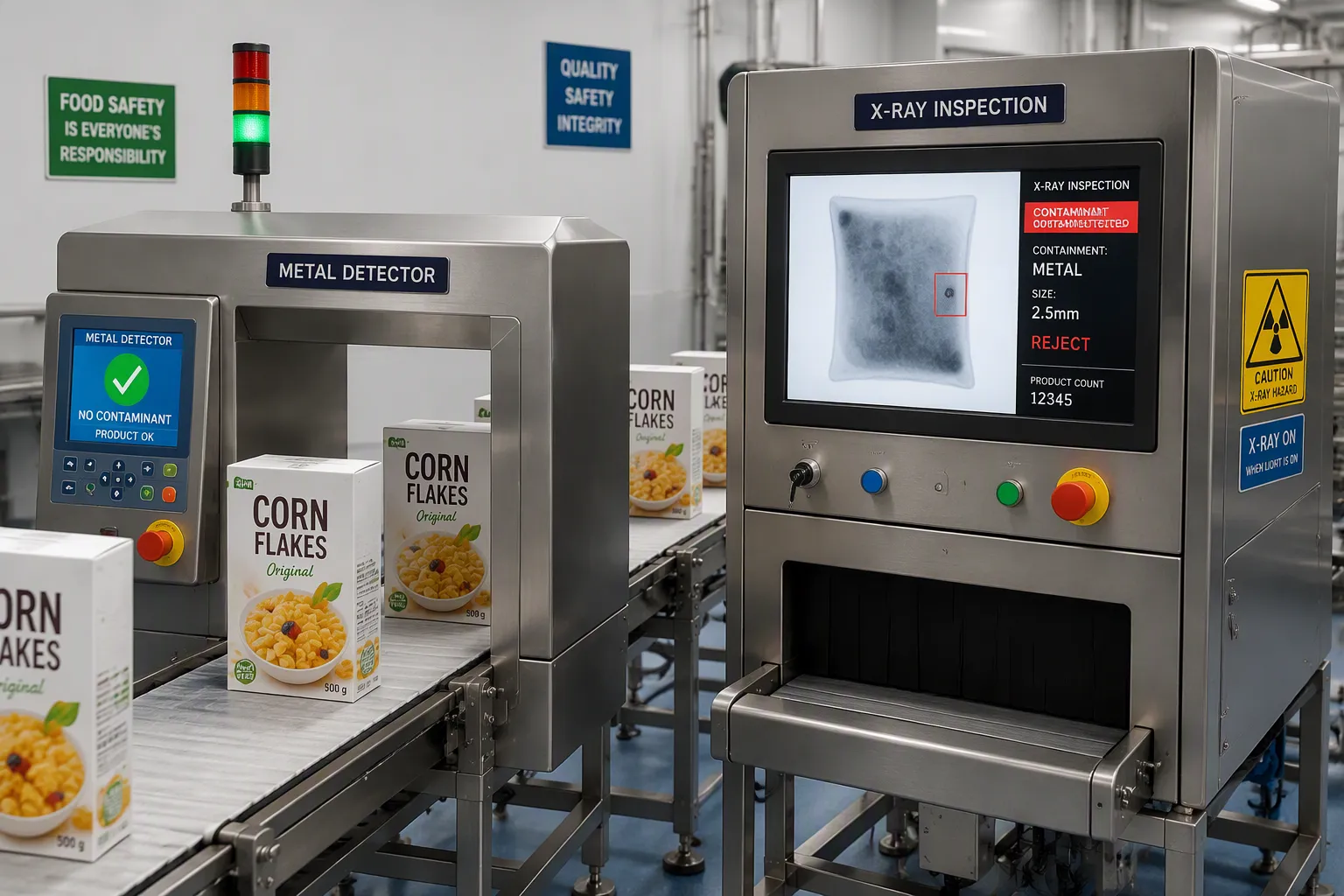
Choosing between a metal detector and an X-ray inspection system shapes your entire foreign body control strategy. Each technology brings distinct strengths and limits. Your product type, contamination risks, and budget determine the right fit.
A metal detector excels at finding ferrous, non-ferrous, and stainless steel contaminants. These systems respond to magnetic and conductive properties. They work exceptionally well for dry, non-conductive products like cereals, snacks, and packaged baked goods. You can place them at multiple points along your line, including front-of-line inspection where smaller apertures boost sensitivity.
Your food metal detector catches all three metal categories. Ferrous pieces trigger strong signals. Non-ferrous metals like copper and aluminum disturb the electromagnetic field through conductivity. Stainless steel presents the hardest challenge due to its low conductivity. Each type requires proper calibration to ensure reliable detection.
Metal detection faces real constraints. Aluminum foil packaging generates strong disruptive signals that mask contaminants and cause false rejects. Specialized detectors with foil compensation filter out the aluminum background signal while maintaining sensitivity to magnetic metals. This reduces false rejects and improves throughput.
Metal detectors might not be effective with aluminum foil packaging. X-ray inspection system would work better in this situation.
Wet, salty, or acidic products create their own "product effect" that complicates detection. Multi-frequency technology helps mitigate this issue. Product orientation also matters. A piece lying flat behaves differently than one standing upright. You must test both orientations during validation.
X-ray systems see beyond metal. They detect a wider range of foreign objects by measuring density differences. This capability makes them valuable for comprehensive food safety programs.
X-ray inspection system catches contaminants that metal detectors cannot:
Glass fragments from containers, processing equipment, or packaging
Bone and calcified tissue such as bone chips in meat, fish bones, and cartilage
Stone and mineral including grit, pebbles, and mineral deposits in vegetables and grains
Dense plastic and rubber fragments from gaskets, conveyor belts, or packaging materials
Contaminant Type | Metal Detector Capability | X-ray Inspection Capability |
|---|---|---|
Not detectable | Detectable – creates dark shadow due to density difference | |
Bone (non-metallic) | Not detectable | Detectable – blocks X-rays, appears as dark shadow |
Very thin metal (e.g., rust, foil) | Detectable – strong effect on magnetic fields | Limited – X-rays pass through thin material |
X-ray inspection systems require more space and a higher investment. They also run slower. Metal detection can inspect up to 400 meters per minute, while X-ray inspection systems handle about 120 meters per minute. This speed difference matters for high-volume production lines.
Your decision depends on several practical factors. Consider your product characteristics, likely contaminants, and production environment.
Product type: Dry, non-conductive products suit metal detection. Conductive products with moisture or salt complicate detection. Product size, density, shape, and orientation all affect performance.
Packaging: Metal detection works with metalized film but not aluminum foil. X-ray penetrates through foil. For non-metal packaging, both work, but metal detection costs less.
Contaminant types: If only metal is likely, metal detection is best. If glass, stone, or dense plastics are possible, X-ray is required.
Production stage: Metal detection works early in the line to remove large metal contaminants. X-ray works better at end-of-line combined with quality checks.
Space and budget: Metal detectors take less space and cost less. X-ray inspection systems need more space and higher investment.
Additional quality checks: X-ray can perform mass measurement, fill level checks, and seal integrity verification. These extras justify its cost when needed.
Many facilities use both systems. A metal detector at the front of the line removes large metal contaminants early. An X-ray inspection system at the end catches non-metal foreign body contamination and performs final quality checks. This layered approach provides complete protection against foreign body contamination.
COSO offers both metal detectors and X-ray inspection systems. Their detection systems cover the full spectrum of contamination risks. You can build a customized solution that meets your specific food processing needs and complies with all relevant standards. This flexibility helps you achieve robust metal detection in food packaging while controlling costs effectively.
You now have the key steps for compliance. Understand your metal detection technology. Integrate it into your HACCP plan as a critical control point. Validate and verify your system regularly. Adhere to safety standards and certification protocols. Maintain a robust calibration program. This safety compliance guide gives you a strong foundation.
This work is not a one-time task. It is an ongoing process. You must check your system every day to protect your food production from contamination. Following these steps ensures safety and quality for your customers.
Review your current metal detection program today. Partner with a reliable manufacturer like COSO for customized solutions. Their equipment meets all regulatory standards. Protect your brand and your consumers.
Validation shows your system can find metal. Verification checks that it still works every day during production. Both need records for audits.
Test when you start a run, every 30 to 60 minutes during production, and when you stop. Test after repairs or product changes. Your schedule must match your risk level.
No. It finds ferrous, non-ferrous, and stainless steel. It cannot find glass, stone, or bone. Those need X-ray inspection systems.
For dry food, common start points are 0.5 mm for ferrous, 0.85 mm for stainless steel. Check these limits for each product you make.
That depends on your risks. If only metal is a risk, a detector works. If non-metal objects are a risk, you need X-ray inspection system. Your plan should cover both for full protection.
Keep validation reports, daily test logs, calibration certificates, and records of fixes. These meet safety standards. Your records must match certification rules.
Wet or high-moisture products often produce strong product-effect signals that resemble those of metal contaminants, making it difficult to differentiate between the two. This can lead to false alarms and unnecessary rejects. Proper system balancing during food processing helps maintain stable detection performance.
Product effect from moisture, salt, and sugar causes false rejects. High-frequency settings find smaller bits but may cause more false rejects on some foods.

