

 +86 15814116500
 Views: 0 Author: Site Editor Publish Time: 2026-09-16 Origin: Site


You might think needle detectors and metal detectors do the same job. They both find metal, but they are used for different reasons. A needle detector is a special tool for catching tiny, broken needles in food and fabrics. Metal detectors are wider tools that find any metal object. This article is a helpful guide to picking the right one for your industry and quality checks. Every year, textile plants in North America report 200 to 300 needle injuries. One incident in 2019 caused 875,000 clothing recalls. These numbers show why proper checking matters. Use this guide to keep your products safe and protect your business.
Needle detectors are made to find small broken needles and wire pieces, while metal detectors find all kinds of metal.
Choose a needle detector when broken needles are the biggest danger, like in textiles or food processing.
Metal detectors guard against many kinds of metal, like iron, other metals, and stainless steel, in lots of different industries.
Needle detectors use high-frequency magnetic fields and digital signal processing to find very thin wires with high sensitivity.
Metal detectors work with balanced coil systems and need careful calibration to balance sensitivity and false rejection rates.
Things like moisture and salt in your product can change how the detector works, so always test your actual products before buying.
Think about your production setup, like how fast the conveyor moves and how much space you have, when you pick a detector.
Talk to experts and try detectors on-site to find the right one that balances detection power, reliability, and total cost.
A needle detector is a precise tool made for one job: finding broken needles and tiny metal bits. You use it when your product must have no small, dangerous metal pieces that could hurt people. This device is good at finding needles that break during making things, especially in clothes and food.
Needle detectors are great at finding ferrous and magnetic needles (like those with iron). The technology in these devices is very sensitive. For example, COSO's Needle Detector can find metal from Feφ0.8mm to Feφ2.5mm, based on your machine's tunnel height. That means you can spot bits smaller than a pinhead. The device uses digital signal processing (DSP) to tell apart tiny metal signals from background noise, so you get reliable results without many false alarms. A high-frequency switching power supply and integrated design help lower part failures, keeping your production line working well.
You will find needle detectors most often in industries where needle breakage is a real danger. Clothes makers use them to check garments, shoes, bags, and toys before shipping. Food makers use them to catch broken needles in meat, chicken, and bakery lines. The device has sound and light alarms, and it can stop and go back automatically. When the detector finds contamination, the belt stops right away, and workers get clear alerts. This quick response makes sure you set aside contaminated products before they reach buyers, protecting your customers and your brand name.
Metal detectors have a wider job. You use them to find any metal object, from big pieces in bulk materials to small metal bits in packaged food. These devices are general-purpose screening tools used in many industries.
A standard metal detector finds ferrous metals, non-ferrous metals like aluminum and copper, and stainless steel. How it works uses a balanced coil system. Three coils work together: one sends out signals in the middle, and two receive on the outside. When no metal goes through, the receiver signals cancel each other. You set the system to a "product profile," which is the normal electromagnetic signature of your product and package. When a metal piece disrupts this field more than a set limit, the detector sets off an alarm, a reject device, or a belt stop.
You will see metal detectors in security checks at airports and event places, where they scan people and bags. In factories, you use them for quality control in food, drug, chemical, and recycling operations. These devices handle larger contaminants and work well for checking raw materials, materials on conveyors, and final packed products. They also protect costly machines from damage by metal bits in production lines.
The main difference is about purpose. A needle detector is a type of metal detection technology, made for a specific danger: thin needles and wire bits. Metal detectors are general tools for wide contamination screening. You pick a needle detector when your risk check shows broken needles are your main worry. You pick metal detectors when you need broad protection against many metal contaminants. You can match the device to your real production risks. Knowing this difference helps you spend on the right inspection tech for your facility.
You might ask how these tools find hidden metal. Each one uses different tech. The needle detector uses high-frequency magnetic fields to find tiny wires. Standard units use balanced coil systems for bigger items. These ideas help you choose.
The tool for finding broken needles makes a high-frequency magnetic field. This field can spot thin wires and small bits. When metal enters the field, it changes the signal. The machine then warns you. The high frequency lets it find needles smaller than a pinhead.
The system runs at a higher frequency than normal machines to sense very thin metal wires. COSO's model can detect metal from Feφ0.8mm to Feφ2.5mm, and its high-frequency power supply cuts down part failures. You get steady detection even on fast production lines.
Products can cause interference, as wet food or thick fabric can hide tiny metal signals. The device uses digital signal processing to tell apart needle signals from product noise by learning your product's normal electromagnetic signature. When a needle piece enters, the system spots the change, lowering false alarms and helping you catch dangerous items.
Standard units work differently, using a balanced coil system with three coils. One sender and two receivers sit inside the head; the sender creates a steady magnetic field. When no metal is present, the receiver signals cancel each other; metal breaks this balance, and the machine sets off an alarm.
Here are the steps in a balanced coil system:
The sending coil gets AC power. It makes an alternating electromagnetic field.
This field goes through your product. If it meets a conductive metal object, it creates eddy currents.
These eddy currents make their own secondary electromagnetic field that breaks the original balanced field.
The receiving coil, normally set to cancel the sender field, notices this break.
The system reads the signal's strength and phase. It figures out the size, depth, and conductivity of the target.
Different metals have different conductivity; iron, aluminum, and stainless steel each react differently to magnetic fields. The detector uses two main ways to handle this variety. The table below compares them.
Detection Method | Operating Principle | Signal Processing for Conductivity |
|---|---|---|
VLF (Balanced Coil) | Sends a steady sinusoidal field (3-100 kHz) and measures phase shift changes caused by eddy currents. | Looks at frequency-dependent impedance changes; phase shift between sent and received signals shows conductivity and magnetic properties. |
Pulse Induction (PI) | Sends short, high-energy pulses (50-500 microseconds) and measures decay time of the secondary magnetic field from eddy currents. | Measures time-domain response; longer decay times mean higher conductivity. |
VLF detectors are common in industrial quality control, while PI detectors work better in tough conditions like aluminum foil packaging.
The tech behind each device decides where you use it. The specialized machine is best for finding tiny items in textiles and food, while a standard unit is better for larger metal pieces in raw materials. Knowing how metal detectors work helps you pick the right tool by matching the detection method to your specific contamination risk. You can set up your inspection line as needed.
A needle detector focuses on one narrow threat: broken needles and wire fragments. You rely on this device when your main risk comes from thin, sharp metal pieces that break during production. The machine excels at finding these tiny hazards because its high-frequency field senses very small ferrous and magnetic objects with accuracy.
When a needle snaps on a sewing line, the broken tip can hide deep inside fabric layers or food products. A needle detector finds these fragments with remarkable precision. COSO's model detects metal pieces from Feφ0.8mm to Feφ2.5mm, depending on your machine's tunnel height. That sensitivity means you catch fragments smaller than a pinhead before they reach your customers. The device uses digital signal processing to separate needle signals from background noise, so you get reliable results without constant false alarms.
You should know that a needle detector only finds metal. It cannot spot glass shards, bone fragments, hard plastic pieces, or stone chips. If your production line faces risks from non-metallic contaminants, you need additional inspection methods. Many manufacturers pair a needle detector with an X-ray inspection system for complete protection. The needle detector handles the metal threat, while X-ray technology catches other foreign objects.
Metal detectors cast a wider net. You use them to find many types of metal contaminants across different sizes and shapes. These devices serve as general-purpose screening tools in factories, warehouses, and security checkpoints.
A standard metal detector identifies three main metal categories. Ferrous metals contain iron and respond strongly to magnetic fields. Non-ferrous metals like aluminum, copper, and brass conduct electricity well. Stainless steel presents the hardest challenge because its low conductivity produces a weaker signal. The detector's balanced coil system handles all three types, though sensitivity varies by metal. You can adjust the settings to match your product's normal electromagnetic signature, reducing false rejects while maintaining reliable detection.
Standard metal detectors struggle with very thin wires and tiny needle fragments. The signal from a fine wire can fall below the detection threshold, especially when the wire lies flat or at certain angles. Product depth also matters. A needle buried deep inside a thick product may escape detection because the signal weakens with distance. These limitations matter when your risk assessment identifies needles as your primary threat.
Here is the key point about detection capabilities. A standard metal detector can find needles in some cases, but it may miss them due to orientation, depth, or small size. A dedicated needle detector offers more reliable results for locating needles in fabric or food products. Needle detectors are used in textile manufacturing to inspect wide materials, ensuring even large rolls are free of broken needles. They can be tailored to handle broad material spans and slower conveyor speeds, giving manufacturers confidence in product safety and quality.
The critical gap comes down to matching the tool to your threat. If needles pose the main danger, a dedicated needle detector remains the gold standard for protection. If you need broad coverage against many metal types, choose metal detectors instead. Your choice directly affects your inspection effectiveness and your ability to meet safety standards.
Precision is what makes a detection system useful instead of annoying. You need equipment that catches real dangers without stopping your line for false alarms. The calibration process decides how well your device works in real situations. Both needle detectors and metal detectors need careful setup, but they face different problems.
A needle detector must sense very small metal pieces. This requires exact calibration. You cannot just turn the sensitivity to maximum and hope for good results. The device needs tuning to match your specific product and environment.
Your product itself gives off signals that interfere with detection. Moisture content matters a lot. Wet products like fresh meat or poultry conduct electricity differently than dry goods like textiles or crackers. Salt content also changes the electromagnetic field around your product. Dense or mixed items produce stronger background noise that can hide tiny needle pieces.
You must think about these factors during setup. The detector learns your product's normal electromagnetic signature. It then ignores that baseline signal while staying alert to changes caused by metal. This balancing act gets harder with wet or salty products. The calibration process requires testing with real product samples to find the right sensitivity level.
COSO's needle detector makes this challenge easier with adjustable settings. You can tune the device to fit different product sizes and features. The system uses digital signal processing to separate needle signals from product noise. This technology helps you keep high sensitivity even when your product causes interference.
The detector can find metal pieces from Feφ0.8mm to Feφ2.5mm, depending on your machine's tunnel height. That level of precision catches broken needle tips smaller than a pinhead. The high-frequency switching power supply reduces part failures, so your calibration stays steady over time. You get reliable performance without constant readjustment.
Metal detectors serve broader purposes, so their calibration involves different trade-offs. You must balance the desire to catch every contaminant against the need to avoid rejecting good products.
Setting your metal detector requires finding the sweet spot. Low sensitivity settings may miss contaminants completely. High sensitivity settings trigger too many rejections, wasting good product and slowing your line. The right balance depends on your specific product and risk tolerance.
You adjust frequency settings to get the best sensitivity for each product type. A product with high salt content or moisture needs different tuning than a dry, uniform item. Regular testing with known contaminants helps you check that your settings stay correct as conditions change.
The aperture size plays a key role in detection ability. A smaller aperture relative to your product size boosts sensitivity significantly. This relationship exists because sensitivity is measured at the geometric center of the aperture, which is the least sensitive position.
Metal detection sensitivity depends on the contaminant's position within the aperture. The center is the least sensitive point, making it the best location to test performance. As metal moves closer to the sides and coils, the signal grows stronger and easier to detect.
You should pick the smallest aperture that fits your product. This simple change improves detection without needing more complex adjustments to your system.
Each device type has its own standard of excellence. For finding fine needles in textiles or food, the dedicated needle detector sets the benchmark. Its high-frequency field and specialized processing deliver unmatched sensitivity for thin wires and small pieces.
For broader contamination control, metal detectors represent the industry standard. They handle ferrous, non-ferrous, and stainless steel contaminants across many products. The choice between them depends on your main threat. If broken needles pose the biggest risk, invest in a needle detector. If you need full screening against many metal types, metal detectors provide the flexibility you need. Your inspection strategy should match the specific dangers your production line faces.
Food production lines face constant risks from broken needles. Meat and poultry processors use needles for injections and tenderizing. Bakery operations rely on wire brushes and metal mesh that can shed fragments. A needle detector catches these tiny hazards before products reach store shelves. You place the device at critical points along your food production line, often after packaging. When the detector finds contamination, the belt stops immediately. Workers remove the affected product and restart the line. This process protects consumers from serious injury and shields your brand from costly recalls.
Textile manufacturers face similar dangers. Sewing needles snap at high speeds, sending fragments into fabric layers. Upholstery shops work with heavy materials that hide broken pieces easily. Needle detectors are used in textile manufacturing to inspect wide materials. They can be tailored to handle broad material spans and slower conveyor speeds, checking every roll before shipment and giving manufacturers confidence in product safety and quality.
Security metal detectors serve a completely different purpose. You find them at airports, border checkpoints, and public event venues. These devices use radio frequency signals to react to moving metal, such as coins in pockets or concealed weapons. The demand for these systems continues growing worldwide. North America holds a significant share of the global handheld detector market as of 2024. Homeland security agencies, defense forces, and airport authorities deploy these units in large numbers. Their job is simple: keep dangerous metal objects away from protected areas.
Industrial operations use metal detectors for broader contamination control. Mining companies screen raw material to protect crushers from metal damage. Recycling facilities sort scrap and remove unwanted metal pieces. Food processors place metal detectors and X-ray systems at multiple points on the same production line. These detectors catch metal shavings from equipment, broken glass, and shells from products that should have been unshelled. The table below shows common uses for metal detectors across different sectors.
Application Domain | Specific Use Cases | Large-Scale Deployment Example |
|---|---|---|
Security Screening | Airports, border checkpoints, public event venues | US homeland security agencies and airport authorities are major deployers |
Industrial Safety | Oil refineries, mining operations, manufacturing plants | Handheld metal detectors used in industrial safety settings |
You might assume a standard metal detector handles every situation. That assumption can cost you. Standard units struggle with very thin wires and tiny needle fragments. The signal from a fine needle can fall below the detection threshold, especially when the needle lies flat or sits deep inside a thick product. But for needle-specific threats, a dedicated needle detector remains the gold standard.
Your inspection strategy should match your actual risks. If broken needles pose the main danger, invest in a needle detector. If you need broad protection against many metal types, choose metal detectors instead. COSO serves industries like toys, clothing, textiles, and footwear, providing tailored solutions for each sector. The right device depends on your product, your threats, and your commitment to consumer safety.
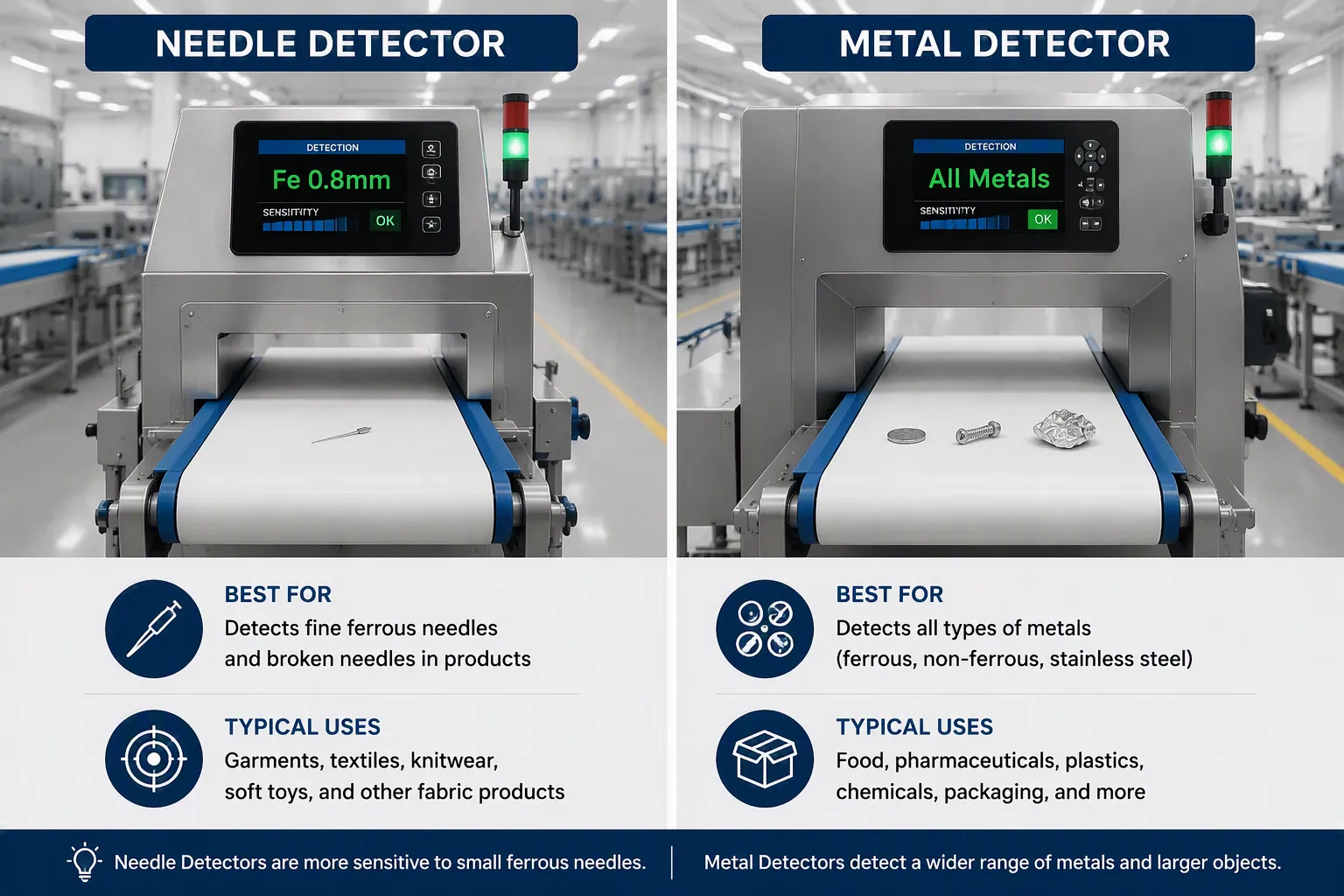
You now understand how both devices work and where each one excels. This section pulls everything together into one clear picture. The table below shows the main differences at a glance, so you can compare your options quickly.
Comparison Point | Needle Detector | Metal Detector |
|---|---|---|
Primary Purpose | Finds broken needles and fine wire fragments | Finds all metal types, from small bits to large pieces |
Target Contaminant | Ferrous and magnetic needles, tiny wire pieces | Ferrous, non-ferrous, and stainless steel objects |
Sensitivity Level | Very high for thin, small metal pieces | Moderate to high, depends on aperture size and product |
Typical Industries | Textiles, garments, toys, food processing | Food, pharmaceuticals, mining, recycling, security |
Detection Range | Feφ0.8mm to Feφ2.5mm depending on tunnel height | Varies widely based on model and aperture configuration |
False Rejection Risk | Lower due to digital signal processing | Higher if sensitivity settings are too aggressive |
Best Use Case | Products where needle breakage is the main danger | Lines needing broad protection against many contaminants |
The purpose drives your choice more than any other factor. A needle detector exists for one narrow job: catching broken needles and fine wire fragments that break during production. You use this device when your risk assessment shows needles pose the main threat to your products. Textile plants, garment factories, and food processors rely on this specialized tool because sewing needles snap at high speeds and hide inside fabric layers or food items.
Metal detectors serve a wider mission. You use them to find any metallic contaminant, whether it appears as a tiny shaving from worn equipment or a larger piece of scrap metal. These devices screen raw materials, in-process products, and finished goods across many industries. The different types of metal detectors available today range from tunnel-style units for packaged goods to gravity-fed systems for bulk powders and granules. Each design addresses a specific production layout, but all share the same broad goal of catching metal before it reaches your customer.
The critical gap between these tools comes down to threat specificity. A standard metal detector can find needles in some situations, but it may miss them due to orientation, depth, or small size. A dedicated needle detector offers more reliable results for locating needles in fabric or food products. You must match the tool to your actual danger. If broken needles represent your primary risk, choose the specialized device. If you need comprehensive coverage against many metal types, metal detectors provide the flexibility you need.
Sensitivity separates these two devices most clearly. A needle detector achieves remarkable precision for fine wires because its high-frequency magnetic field can sense very small ferrous and magnetic objects. COSO's model detects metal pieces from Feφ0.8mm to Feφ2.5mm, depending on your machine's tunnel height. That level of sensitivity catches broken needle tips smaller than a pinhead. The device uses digital signal processing to separate needle signals from product noise, so you get reliable results without constant false alarms.
Metal detectors offer good sensitivity but face different challenges. Their balanced coil systems detect ferrous, non-ferrous, and stainless steel contaminants. However, sensitivity depends heavily on aperture size. A smaller aperture relative to your product size boosts detection ability significantly. The center of the aperture remains the least sensitive point, so you should test performance there. You also need to balance detection range against false rejection rates. Setting sensitivity too high triggers unnecessary product loss. Setting it too low lets contaminants slip through.
Calibration requirements differ too. A needle detector learns your product's normal electromagnetic signature and ignores that baseline while staying alert to changes caused by metal. Wet or salty products create more background noise, making calibration trickier. COSO's needle detector offers adjustable settings to accommodate various product dimensions and characteristics. Metal detectors require similar tuning, but you must account for a wider range of metal types and sizes. Regular testing with known contaminants helps you verify that your settings remain correct as conditions change.
Budget considerations often shape your final decision. A needle detector typically costs less than a full metal detection system because it focuses on one specific threat. The device operates with simpler controls and requires less training for your staff. Needle detectors are available in both conveyor and non-power models, giving you flexibility based on your production layout. The non-power option works well for checking individual items or small batches without integrating into a conveyor line.
Metal detectors generally represent a larger investment. You pay for broader detection capabilities, more complex signal processing, and additional features like automatic rejection systems. The different types of metal detectors available today also vary in price based on their construction. Waterproof models for wet processing areas cost more than standard units. Explosion-proof designs for hazardous environments command a premium. You must also factor in installation costs, conveyor integration, and ongoing maintenance.
Operational complexity follows a similar pattern. A needle detector offers straightforward operation with sound and light alarms. When the device finds contamination, the belt stops immediately, and workers remove the affected product. Metal detectors require more careful setup and ongoing adjustment. You need to program product profiles, set sensitivity levels, and manage rejection systems. False rejects waste good product and slow your line, so you must monitor performance regularly.
The gold standard for your facility depends on your specific risks and budget. Choosing the right equipment allows you to match your specific needs. A needle detector delivers unmatched precision for fine needles at a lower cost. Metal detectors offer broader protection but require more investment and expertise. Your inspection strategy should reflect the real dangers your production line faces. Evaluate your threats honestly, test your products with both devices, and select the tool that keeps your customers safe without breaking your budget.
You now know the technical differences between these tools. The next step is picking the right one for your workplace. This choice needs a clear plan. You must look at your specific dangers, study how you make your products, and test real items before buying. Follow this guide to choose the tool that keeps customers safe and saves you money.
Every production line has different contamination dangers. You cannot pick the right tool without knowing what risks exist in your process. Start by listing every way metal could get into your products. Walk through your factory and watch each step. Ask workers about past contamination events. Look at customer complaints and recall records. This information builds your risk check.
The type and size of metal bits decide which tool you need. Ask yourself what breaks or wears away during production. Sewing needles snap when making clothes. Wire brushes lose bristles in food bakeries. Cutting blades chip during plastic work. Each case creates a different detection problem.
Needle pieces are very small, often smaller than a pinhead. Standard metal detectors may miss these tiny bits because the signal is too weak. A special needle detector works best here. COSO's model finds metal from Feφ0.8mm to Feφ2.5mm, based on your machine's tunnel height. That sensitivity catches fragments you cannot see.
Bigger bits need a different method. If your danger is metal shavings from old equipment or loose bolts from machines, a standard metal detector does the job. These tools find ferrous, non-ferrous, and stainless steel objects in many sizes. You match the tool to your specific risk.
Your product itself affects how well detection works. Moisture changes how electromagnetic fields behave. Wet products like fresh meat conduct electricity differently than dry goods like crackers or cloth. Salt content also changes the signal. Thick or mixed items create more background noise that can hide small metal bits.
You must think about these properties when choosing equipment. A needle detector uses digital signal processing to learn your product's normal electromagnetic signal. It then ignores that baseline while staying alert to changes from metal. This tech works well for both dry cloth and wet food. But you need to test your specific product to confirm it works.
Your factory layout and work needs shape the final choice. A tool that works great in one plant may fail in another because of space limits or line speed. Study your environment honestly before buying.
Production speed directly affects detection effectiveness. Faster lines give the detector less time to check each product. You need equipment that keeps up with your speed without losing sensitivity. Needle detection systems are available for wide materials running at slower speeds, fitting both material size and conveyor pace.
Think about your busiest production times. A detector that works at normal speeds may struggle during busy seasons. Choose equipment with a safety margin for your fastest conditions. This approach stops backups and keeps your line moving well.
Physical space often limits your options. Measure the area where you plan to put the detector. Account for the device size, conveyor length, and room for maintenance. Needle detectors are available in both conveyor and non-power models. The non-power option works well for checking single items or small batches without hooking into a conveyor line.
Think about how the detector connects with your current equipment. Does it need to link with reject devices or alarm systems? Will it talk to your production control software? These integration needs affect both cost and complexity. Plan for these connections before installation begins.
You do not have to make this choice alone. Equipment makers have lots of experience across many industries. Their knowledge helps you avoid costly mistakes. Equipment manufacturers can recommend the right solution without bias.
Never buy detection equipment without testing your actual products. Lab conditions differ from real factory settings. Your product's unique traits affect detection performance in ways you cannot guess from specs alone. It is advisable to send product samples for testing before purchase. Manufacturers can run your materials through different detectors to find the best match.
During testing, check both sensitivity and false reject rates. A detector that catches every contaminant but rejects 20% of good products costs you money. The right balance maximizes protection while cutting waste. Testing shows this balance before you invest in equipment.
The purchase price is only part of your total cost. You must also add installation costs, worker training, upkeep, and possible downtime. A cheaper detector that needs frequent calibration or breaks down often costs more over its life than a reliable unit with a higher upfront price.
Compare the different types of metal detectors available. Waterproof models for wet areas cost more than standard units. Explosion-proof designs for dangerous places cost even more. These features protect your investment in tough conditions. The best choice for your factory balances detection power, reliability, and total cost.
Your final choice should fit your specific risks, production setting, and budget. Contact equipment manufacturers for product testing and custom solutions. Their team helps you look at your options and pick the equipment that keeps your products safe without slowing your work.
Your choice between a needle detector and a metal detector depends on your specific threat and industry requirements. Needle detectors provide unmatched sensitivity for fine needles in food and textile safety. Metal detectors offer broader protection against many contaminant types across various industries. Evaluate your production line risks honestly. Identify your primary contaminant type and size. Test your products with both solutions to find the best match. Consult with equipment manufacturers for expert guidance. Choosing the right equipment ensures a tailored fit for your manufacturing process. The right detector protects your customers and your brand while maintaining production quality. Choose the correct inspection tool for your facility today.
A standard metal detector can sometimes find needles. But it might miss thin pieces because of how they sit, how deep they are, or their tiny size. To reliably find needles in cloth or food, you need a special needle detector. It uses higher frequency fields and special signal processing.
You need a needle detector if your work involves sewing, quilting, or needle injection. Textile plants, clothing makers, toy companies, and food processors use these tools. Any place where needles can break and hide inside products should use this special checking equipment.
Test your detector at the start of each shift and after any repair work. Use test samples with known metal pieces to check sensitivity. Regular testing makes sure your equipment catches contaminants every time. Write down every test result for safety checks and quality records.
A needle detector focuses on finding fine, broken needles and wire pieces. A metal detector looks for wider contamination from ferrous, non-ferrous, and stainless steel objects. Your choice depends on your main risk. Needle detectors give better sensitivity for thin wires, while metal detectors offer broader coverage.
You can use a metal detector for general screening, but it may not catch fine needles well. For full protection, many makers install both systems at different points. A needle detector handles cloth and food lines where needle breakage is the main risk. A metal detector checks raw materials and bulk products.
Wet or salty products create more electromagnetic noise that can hide small metal pieces. You need to set up your detector using real product samples. Digital signal processing helps separate contaminant signals from product interference. Testing with your own products ensures reliable detection in real conditions.
Food safety rules require you to set up hazard analysis and critical control point plans. These plans often require metal detection for needle risks. You should check industry-specific guidelines and local laws. Your detection equipment must meet written sensitivity standards to pass audits and protect consumers.
Yes, product traits affect detection performance. Dense, thick, or conductive products need different setup than light, dry items. Detectors with adjustable settings are available for various product sizes. You may need multiple units or custom settings to keep sensitivity across your whole product range.

