

 +86 15814116500
 Views: 0 Author: Site Editor Publish Time: 2025-10-29 Origin: Site


Are you sure your products meet the correct weight standards? Checkweighers are vital for ensuring accuracy in various industries. They play a key role in quality control and compliance. In this article, we'll explore the different types of checkweighers and help you choose the right one for your business.
In-motion checkweighers are dynamic weighing systems designed to measure the weight of moving products on a conveyor belt. Unlike traditional scales, in-motion checkweighers allow products to be weighed continuously without interrupting the production process. This capability is ideal for high-speed production lines where efficiency and speed are essential.
High-Speed Operation: In-motion checkweighers can handle large volumes of items, weighing them accurately as they move along the conveyor.
Advanced Technology: Many in-motion checkweighers use high-frequency load cells or electromagnetic force restoration to ensure precise weight measurement even at high speeds.
Automation: These systems can automatically reject items that are either underweight or overweight, using mechanisms like pneumatic arms or air-jets.
In-motion checkweighers are commonly used in industries such as food production, pharmaceuticals, packaging, and logistics. For example:
Food production: In-motion checkweighers ensure products are correctly portioned and comply with industry standards.
Pharmaceuticals: These checkweighers help maintain strict weight accuracy for medication packaging.
Logistics and warehousing: They are used to verify the weight of packages as they move through the distribution process.
Tip: When choosing an in-motion checkweigher, ensure it can handle your product size and production speed without compromising on accuracy.
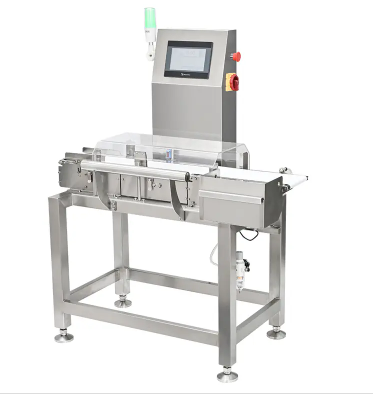
Static checkweighers, also known as benchtop checkweighers, are designed to weigh stationary products. Unlike in-motion checkweighers, these devices require the product to stop moving before being weighed. Static checkweighers offer exceptional accuracy, making them ideal for high-precision applications.
High Accuracy: Static checkweighers excel in precision, providing reliable weight measurements for small or delicate items.
Simple Operation: These checkweighers are easy to operate, with minimal setup required. Ideal for small batch production or manual inspection processes.
Cost-Effective: Static checkweighers are typically less expensive than their dynamic counterparts, making them a good choice for smaller operations.
Static checkweighers are often used in industries where small-scale or high-accuracy measurements are required:
Pharmaceuticals: To ensure correct dosage weights in drug packaging.
Jewelry Manufacturing: For weighing precious metals and gemstones accurately.
Chemical Labs: Where precise weight measurements are necessary for experiments or formulations.
Note: Static checkweighers are best suited for low-volume production and small, delicate products that require fine accuracy.
Combination checkweighers combine weight measurement with additional inspection capabilities, such as metal detection, X-ray inspection, or vision systems. These multi-functional devices not only verify the weight of products but also check for contaminants, foreign objects, or packaging defects.
Multi-Functionality: By integrating metal detection or X-ray inspection, these systems offer comprehensive quality control in a single unit.
Space-Saving: Combining multiple inspection processes into one device reduces the need for additional equipment, saving valuable floor space.
Enhanced Product Integrity: They help identify and reject products with foreign contaminants, improving the overall safety and quality of the production line.
Combination checkweighers are particularly useful in industries where product integrity is critical:
Food Industry: To ensure products are free from metal contaminants and meet weight requirements.
Pharmaceuticals: For checking both weight and ensuring that no foreign particles or contaminants are present.
Packaging: For verifying that packages are correctly sealed and contain the correct weight of goods.
Consider using a combination checkweigher if you need to maintain high standards of product quality and integrity, especially in industries with strict safety regulations.
Benchtop checkweighers are small, portable systems designed for weighing stationary products. These devices are compact and versatile, making them suitable for small-scale operations, laboratories, or for use in environments where space is limited.
Portability: Benchtop checkweighers are lightweight and easy to move, making them ideal for research labs or temporary workstations.
Space-Efficient: Their compact design makes them perfect for operations with limited floor space.
Affordability: They are generally less expensive than other types of checkweighers, providing an accessible option for small businesses or startups.
Benchtop checkweighers are best suited for industries and applications where portability and precision are required:
Research Labs: For weighing small batches of products or samples.
Small-Scale Production: In operations that require frequent manual inspections and adjustments.
Quality Control: In industries where products are checked in smaller batches or manually.
Benchtop checkweighers are ideal for environments where products need to be weighed in multiple locations or where frequent relocation is required.
Washdown checkweighers are designed to withstand harsh cleaning conditions. They are built with stainless steel frames and high waterproof ratings (IP65 or higher) to endure rigorous washdowns, making them ideal for industries where sanitation is a top priority.
Hygienic Design: Washdown checkweighers are built to resist dust, water, and harsh cleaning agents, ensuring compliance with hygiene standards.
Durability: These systems are designed to last in environments that require frequent cleaning, such as food production or pharmaceuticals.
Easy Maintenance: Their construction makes them easy to clean and maintain, which is critical for avoiding contamination.
Washdown checkweighers are essential in environments with strict sanitation regulations:
Food Production: To ensure hygiene while maintaining accurate weight measurements for food packaging.
Pharmaceuticals: For maintaining clean conditions while weighing sensitive products.
Cosmetics and Personal Care: To prevent contamination during production.
Note: If your operation deals with products that require frequent cleaning, a washdown checkweigher is a must to ensure consistent performance and meet regulatory requirements.
In conclusion, there are various types of checkweighers, each designed to meet the specific needs of different industries. Whether you're looking for high-speed, in-motion checkweighers for continuous production or static checkweighers for precise manual inspections, understanding the unique advantages and applications of each type will help you choose the right equipment for your business.
By selecting the right checkweigher, companies can enhance production efficiency, improve product quality, and comply with industry regulations. It's important to consider factors like product characteristics, environmental conditions, and additional functionality (such as metal detection or X-ray inspection) when making a decision.
COSO ELECTRONIC TECH offers high-quality solutions like in-motion and static checkweighers, ensuring your business meets operational goals with precision and reliability.
A: A checkweigher is a device used to measure the weight of products, ensuring they meet specific weight standards. It's commonly used in industries like food production and packaging.
A: In-motion checkweighers are systems designed to weigh products while they move along a conveyor belt. They are ideal for high-speed production lines, ensuring efficiency and accuracy.
A: Using a checkweigher helps maintain product consistency, ensures regulatory compliance, and prevents underweight or overweight products from reaching the market.

