

 +86 15814116500
 Views: 0 Author: Site Editor Publish Time: 2026-03-06 Origin: Site


Are you searching for the best metal detectors for gold hunting? Some top choices are COSO Electronic’s Industrial Metal Detector, Minelab GPX 6000, Garrett AT Gold, and XP DEUS II. More people want to find gold now because gold prices are going up. So, many people buy better detectors. Picking the right detector helps you find more gold. Understanding how metal detectors work is essential, as they utilize different technologies like VLF, PI, and multi-frequency. Look at the table below to see how each detector works:
Detector Type | Best Applications | Advantages | Limitations |
|---|---|---|---|
VLF | General prospecting | Good discrimination | Struggles with mineralized soil |
PI | Mineralized ground | Deep penetration | Poor discrimination |
Multi-Frequency | Versatile gold hunting | Excellent depth | Complex operation |
High-Frequency VLF | Small gold nuggets | Sensitive to tiny gold | Limited depth |
Pick a metal detector that fits what you need. Look at models like COSO Electronic’s Industrial Metal Detector, Minelab GPX 6000, and Garrett AT Gold. These are good for finding gold.
Know why frequency matters. High frequencies are best for small gold nuggets. Low frequencies are better for finding bigger gold deeper in the ground.
Change the sensitivity settings for the soil. Use lower sensitivity in soil with lots of minerals to stop false signals. Use higher sensitivity in clean soil to find small gold pieces.
Use ground balance features. Manual and automatic ground balance help your detector ignore unwanted minerals. This makes it easier to find gold.
Pick the right coil type for where you hunt. DD coils are good for soil with lots of minerals. Mono coils work better in clean ground and for deeper searches.
Think about comfort and how easy it is to carry. A light and comfy detector lets you hunt longer without getting tired. This makes your experience better.
Take care of your detector often. Clean it after every use and check the battery. This helps your detector work well when you look for gold.
Learn about places where you can hunt. Public lands and old sites often have more gold. Plan your trips to these places.
When you look for gold, frequency is important. Frequency is how often the detector sends signals each second. High frequencies are good for finding small gold nuggets. Low frequencies go deeper and find bigger targets. Check this table to see the difference:
Frequency Type | Small Gold Nuggets | Large Targets |
|---|---|---|
Higher Frequencies | More effective | Less effective |
Lower Frequencies | Less effective | More effective |
Single-Frequency | Great for gold | - |
Multi-Frequency | Not as sensitive | - |
If you want to find tiny gold flakes, use a detector with high frequency. If you want to find bigger gold pieces, use a lower frequency.
Gold sensitivity shows how well your detector finds small gold pieces. Detectors with high sensitivity can spot tiny nuggets. COSO Electronic’s Industrial Metal Detector uses special technology to make sensitivity better. This helps you find gold in hard places, like wet soil or rocky ground.
You need a detector that finds small gold nuggets. High sensitivity is very important. Some detectors let you change sensitivity for different places. In soil with lots of minerals, lower sensitivity for steady signals. In clean ground, raise sensitivity to find tiny gold bits.
Tip: In bad ground, lower sensitivity and speed up recovery. In low mineral ground, raise sensitivity if your detector balances fast.
Adjustable sensitivity helps you get the best results. You can change settings for where you hunt. This makes your detector more stable and accurate. COSO Electronic’s Industrial Metal Detector lets you fine-tune sensitivity. You get good performance, even in tough places like wet or mineral-rich soil.
Ground balance helps your detector ignore minerals in the soil. You can set ground balance yourself or let the detector do it. Manual ground balance gives you control. Automatic ground balance is easier and faster for beginners.
Type of Ground Balance | Description |
|---|---|
Manual | You adjust for mineralization yourself. |
Automatic | The detector calibrates itself with a simple action. |
Tracking | The detector adjusts in real-time as ground conditions change. |
Mineralized soil makes gold hunting harder. Good ground balance keeps your detector stable. COSO Electronic’s Industrial Metal Detector uses smart algorithms to handle tough soils. You can hunt for gold in places with lots of minerals and still get good results.
Key features to look for in a gold detector:
Auto ground balance for mineralized soils
Adjustable sensitivity for different environments
High frequency for small gold nuggets
Lightweight design for comfort
With the right features, you can find more gold and have fun, even in tricky places.
When you hunt for gold, the coil on your metal detector matters a lot. The coil is the round part at the end of your detector. It sends signals into the ground and picks up metal objects. You can choose from two main types: DD coils and Mono coils.
DD coils have two D-shaped wires. They work well in tough ground with lots of minerals. You get better coverage and more stable signals. Mono coils use one wire loop. They go deeper and work best in clean soil. If you search in rocky or mineral-rich places, a DD coil helps you find gold without too much noise. For open fields with less mineralization, a Mono coil can help you dig deeper for bigger nuggets.
Tip: If you hunt in different places, try both coil types. You can switch them out on many detectors, including COSO Electronic’s Industrial Metal Detector, which supports flexible coil options for different environments.
Coil size changes how your detector works. Large coils cover more ground and find bigger gold pieces deeper down. Small coils focus on tiny nuggets near the surface. Round coils give you even coverage. Elliptical coils help you search in tight spots, like between rocks or bushes.
Here’s a quick guide:
Large coils: Go deep, find big gold, cover more area.
Small coils: Spot tiny gold, work well in trashy or crowded spots.
Round coils: Good for general use.
Elliptical coils: Great for narrow spaces.
You can pick the coil that fits your hunting style. COSO Electronic’s Industrial Metal Detector lets you choose the right coil for your job, making it easier to find gold in any setting.
You want to feel good while you hunt for gold. Ergonomics means your detector feels comfortable and easy to use. If your detector fits you well, you can search longer and find more gold.
A comfortable detector makes a big difference. Look for padded armrests and grips. These features stop your hands and arms from getting sore. Adjustable shafts let you set the detector to your height. This helps you stand straight and keeps your back from hurting.
Here’s a table to show how ergonomic features help you:
Ergonomic Feature | Benefit |
|---|---|
Adjustable Telescopic Shaft | Promotes a natural standing posture and reduces back strain |
Padded Armrests and Grips | Reduces pressure points and improves comfort during long outings |
Balanced Weight Distribution | Minimizes wrist fatigue and enhances control during sweeping |
COSO Electronic’s Industrial Metal Detector uses a balanced design. You get less wrist fatigue and more control, even on long hunts.
You may need to carry your detector far from your car or camp. Lightweight detectors are easier to move. Some models fold up or break down into smaller pieces. This makes them simple to pack and carry. If you hike to your gold spot, a portable detector saves your energy for digging.
Note: Always check the weight and size before you buy. COSO Electronic’s Industrial Metal Detector offers portable options, so you can hunt for gold anywhere without feeling tired.
With the right coil and a comfortable, portable design, you can enjoy gold hunting and boost your chances of finding treasure.
If you want to find gold, you should know how metal detectors work. These machines use special technology to help you find gold nuggets, flakes, or bigger pieces in the ground. Let’s look at how they do this and why some detectors are better for gold.
Gold detectors use two main types of technology: VLF and PI. Each type has its own strengths.
VLF detectors use frequencies from 3 kHz to 30 kHz. They are good for finding small gold pieces in soil with few minerals. Some VLF detectors, like Gold Finder, use even higher frequencies, like 56 kHz. This helps you find tiny gold nuggets, but you might not reach deep underground.
PI detectors send out short bursts of current. They work well in places with lots of minerals, like red or black soil. PI detectors can find gold deeper underground, so they are great for serious gold hunters.
Here’s a table to show the main differences:
Feature | VLF Detectors | PI Detectors |
|---|---|---|
Transmission Method | Continuous sine wave | Short bursts of current |
Soil Suitability | Mild to moderately mineralized soils | Heavily mineralized regions |
Target Identification | Good target ID capabilities | Limited or basic target ID |
Depth Capability | Limited depth on small gold | Exceptional depth in mineralized soil |
Weight and Cost | Lighter and lower cost | Heavier and more expensive |
Best For | Beginners, low mineralization areas | Experienced prospectors, deep-nugget hunting |
VLF detectors are lighter and cost less. They are good for beginners and for soil that is not too tough. PI detectors go deeper and work better in hard ground, but they are heavier and cost more.
Modern metal detectors are smarter now. They use advanced algorithms to help you find gold in tricky spots. These algorithms help the detector ignore signals from minerals in the soil. You get fewer false alarms and more real gold finds. Some detectors can adjust themselves as you move, so you do not have to stop and change settings.
COSO Electronic’s Industrial Metal Detector is special because it uses smart detection technology. This detector works well in many places, like wet soil, dust, or even places with explosive risks. You can trust it to find both small and large gold pieces. It uses intelligent signal processing, so you get fewer false signals and more accurate results. The detector can spot ferrous and non-ferrous metals, so you do not miss any gold.
You can use this detector in many industries, not just gold hunting. It fits into conveyor belts, gravity systems, and works with alarms and rejection devices. This makes it a good choice if you want a reliable and flexible tool.
COSO Electronic’s Industrial Metal Detector is special because you can customize it. You can change the height and width of the conveyor belt to fit your needs. You can also pick different rejection systems, so the detector works just right for your job. This means you get a detector that matches your gold hunting style and the places you search.
Tip: If you hunt for gold in different places, you can adjust your COSO detector to work better in each spot. This saves you time and helps you find more gold.
When you compare COSO Electronic’s Industrial Metal Detector to other gold detectors, you see some big advantages. Many detectors only work well in certain soils or with certain sizes of gold. COSO’s detector uses advanced technology and smart algorithms, so it works in more places and finds more types of gold. You get stable performance, even in tough conditions like wet or mineral-rich soil.
Other detectors might give you lots of false signals or miss small gold pieces. COSO’s detector reduces false rejects and helps you focus on real gold targets. You also get the benefit of customizing your detector, which is not always possible with other brands.
If you want a detector that works in many environments, finds gold of all sizes, and gives you fewer false alarms, COSO Electronic’s Industrial Metal Detector is a smart choice. Metal detectors work best when they match your needs, and COSO gives you the tools to do just that.
If you are new to gold hunting, you need a detector that is easy to use. Entry-level models are simple and light. They help you find small gold nuggets. You can start using them right away. Many have waterproof coils. You can hunt in shallow water. They also have audio tones. These tones help you know if you found gold or trash. Basic ground balance features are included. This makes learning about metal detectors easier.
Here’s what entry-level gold detectors give you:
Light weight makes carrying easy.
Simple controls help you set up fast.
Waterproof coils let you search in water.
Audio tones help you tell gold from junk.
Manual or basic automatic ground balance.
There are good choices for your first gold detector. Here’s a table to compare top entry-level models:
Detector Name | Technology | Weight | Key Features |
|---|---|---|---|
Minelab Gold Monster 1000 | 45 kHz VLF | 2.8 lbs | Gold Mode, Waterproof coil, Audio tone options, Threshold boost |
Fisher Gold Bug 2 | 71 kHz VLF | 2.9 lbs | 71 kHz frequency, Iron discrimination, Manual ground balance, Lightweight design |
Nokta Legend | Simultaneous Multi-Frequency | 3.1 lbs | Modern multi-frequency technology, Dedicated gold modes |
Each model has something special. The Fisher Gold Bug 2 uses high frequency. This helps you find tiny gold pieces. The Minelab Gold Monster 1000 has a waterproof coil. It is easy to use. The Nokta Legend uses multi-frequency technology. You can hunt in different soils.
Tip: Pick a detector that fits where you like to search. If you hunt near rivers, a waterproof coil is very helpful.
Mid-range gold detectors are stronger and more flexible. They work better in tough soils. You get more settings to change how you hunt. Many mid-range models use VLF or PI technology. VLF detectors are good in moderate mineral soil. They may not work well in very tough ground. PI detectors are best in heavy mineral soil. They work in red dirt or black sand. Some new models, like the Minelab GPZ 7000, use advanced technology. They handle all types of soil.
Here’s a table showing how these detectors work in mineralized soil:
Detector Type | Performance in Mineralized Soil | Pros | Cons |
|---|---|---|---|
VLF Detectors | Good for moderate mineralization | Accurate target ID, lower cost, lighter | Limited depth on small gold |
PI Detectors | Excellent in heavy mineralization | Deep detection, works in wet sand/saltwater | Higher power use, usually no target ID |
Newer Models | Great sensitivity in all soil types | Adapts to changing ground, stable signals | Higher price, takes time to learn |
Mid-range models give you more depth. You get better results in many places.
Mid-range detectors balance price and performance. They cost more than entry-level models. You get more features and better results. These detectors often have:
Adjustable ground balance for tough soils.
Multiple search modes for gold, coins, or relics.
Larger coils for deeper searching.
Better battery life for longer hunts.
If you want to find more gold and try new places, a mid-range detector is a smart buy.
Professional gold detectors have advanced features. They are waterproof. They use high frequencies. Ground balancing is strong. These detectors work in wet places and tough soils. Some models are waterproof up to 66 feet. You can change the frequency. This helps you find small and big gold pieces. Automatic and manual ground balancing lets you hunt anywhere.
Here are features in professional models:
Waterproof for rivers, streams, and underwater.
High-frequency operation finds small gold nuggets.
Advanced ground balancing reduces noise from minerals.
Extreme sensitivity finds tiny or deep gold targets.
Note: Professional detectors have more buttons and settings. You need practice to use all the features.
Professional gold detectors are best for serious hunters. If you want to search tough places or dig deep for big nuggets, these models are for you. You might be a prospector or geologist. You could be a hobby hunter who wants the best tools. These detectors work everywhere, from deserts to riverbeds.
You get the most from a professional detector if you:
Hunt for gold often.
Search in different soils and water.
Want to find small flakes and big nuggets.
Like using advanced settings and features.
With the right model, you see metal detectors at their best. You will find more gold and enjoy hunting even more.
You want a gold detector that fits right into your routine. COSO Electronic’s Industrial Metal Detector does just that. You can set it up on a conveyor belt, use it with a gravity feed, or even connect it to alarms and automatic rejection systems. This means you can use it in many places, from a busy mining site to a small workshop. You don’t have to worry about tough conditions. The detector works in wet, dusty, or even explosive-risk areas. You can pick the coil size, the conveyor width, and the rejection method. This lets you build a system that matches your gold hunting style.
If you need to move your detector, COSO makes it easy. The design is portable and balanced. You can carry it to remote spots or set it up in a fixed location. You get stable performance, even if you change where you hunt. The detector keeps working, so you can focus on finding gold.
Tip: If you hunt in different places, you can adjust your COSO detector for each spot. This saves you time and helps you find more gold.
You might think this detector is just for gold, but it does much more. Many industries trust COSO Electronic’s Industrial Metal Detector. You see it in food factories, chemical plants, textile mills, and even recycling centers. It checks for metal pieces in products and keeps machines safe. In mining, it helps you find gold nuggets, flakes, and even tiny bits that other detectors might miss.
You can use this detector in harsh places. It works in wet soil, rocky ground, and mineral-rich areas. The smart technology inside helps you get fewer false signals. You spend less time digging up trash and more time finding real gold. If you want a detector that works in many industries and tough spots, COSO gives you that power.
Let’s see how the top gold detectors compare. Here’s a table with important details like detection depth, frequency, weight, battery life, and price. This helps you pick the right one for your needs.
Model Name | Detection Depth (cm) | Frequency Range (kHz) | Weight (kg) | Battery Life (hrs) | Price Range (USD) |
|---|---|---|---|---|---|
Minelab GPX 6000 | 45 | 1.6 to 60 (PI) | 2.2 | 8 | $5,900–$6,500 |
Garrett ATX Deepseeker | 40 | PI (25 Pulses/sec) | 2.5 | 10 | $2,100–$2,700 |
Nokta Makro Gold Kruzer | 25 | 61 (VLF) | 1.4 | 19 | $700–$850 |
Fisher Gold Bug 2 | 20 | 71 (VLF) | 1.3 | 26 | $750–$900 |
XP ORX Gold | 25 | 13 – 56 (Selectable) | 1 | 20 | $850–$999 |
Minelab Equinox 900 | 28 | 5 – 40 (Multi-IQ) | 1.3 | 11 | $1,200–$1,350 |
Garrett Goldmaster 24k | 23 | 48 (VLF) | 1.4 | 20 | $800–$999 |
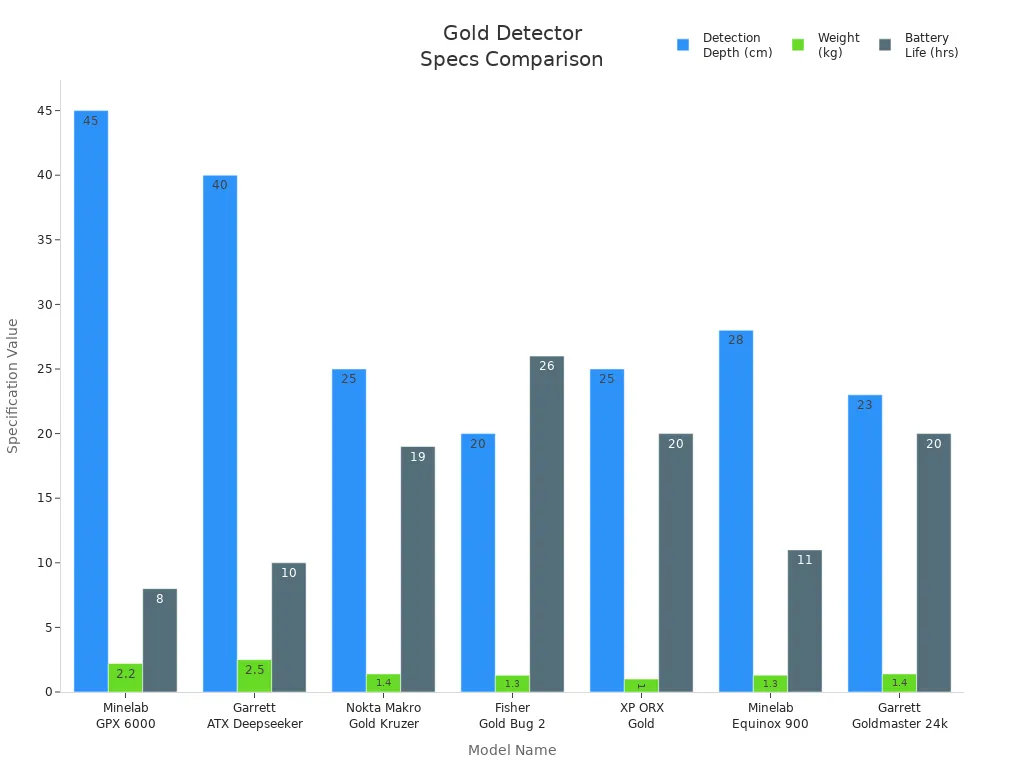
Prices for gold detectors can range from a few hundred dollars to several thousand. Entry-level models like the Fisher Gold Bug 2 and Nokta Makro Gold Kruzer cost less. They work well for beginners and light use. Mid-range models like the Minelab Equinox 900 give you more features and better depth. Professional models like the Minelab GPX 6000 cost more but offer the best performance for serious gold hunters.
COSO Electronic’s Industrial Metal Detector stands out because you can customize it. You pick the features you need, so you get the best value for your money. You invest in a tool that grows with your skills and needs.
Here’s a quick look at what makes each detector special and where they might not fit your needs:
Minelab GPX 6000
Pros: Finds gold deep underground, handles tough soil, advanced features.
Cons: High price, takes time to learn all the settings.
Garrett ATX Deepseeker
Pros: Great for deep gold, works in saltwater, strong build.
Cons: Heavier than other models, costs more than entry-level detectors.
Nokta Makro Gold Kruzer
Pros: Easy to carry, good for small gold, affordable.
Cons: Not the best in very mineralized soil.
Fisher Gold Bug 2
Pros: Spots tiny gold, simple controls, lightweight.
Cons: Not waterproof, struggles in tough soil.
XP ORX Gold
Pros: Super light, wireless, easy to swing all day.
Cons: Digital menu takes practice to master.
Minelab Equinox 900
Pros: Multi-frequency, good for all targets, balanced design.
Cons: Battery life is shorter than some others.
Garrett Goldmaster 24k
Pros: Good sensitivity, solid build, easy to use.
Cons: Not as deep as PI models.
When you look at how Metal Detectors Work, you see that each model has its own strengths. COSO Electronic’s Industrial Metal Detector gives you flexibility, strong performance, and the ability to handle many environments. You get fewer false signals and more real gold finds. If you want a detector that adapts to your needs, COSO is a smart choice.
Note: Always think about where you will hunt and what features matter most to you. The right detector makes your gold hunting more fun and successful.
You may want to start gold hunting without spending a lot. Entry-level detectors are a good deal. These detectors are easy to use and light to carry. You can find many models for $300–$900. Most have basic features like automatic ground balance and preset modes. These features help you begin quickly.
Here are some things to check in affordable detectors:
Automatic ground balance makes it simple.
Adjustable sensitivity works in different soils.
Lightweight design is comfortable to hold.
Simple controls are easy to understand.
Good warranty and support help if you need it.
You do not need to spend a lot to find gold. If you want a detector that grows with you, COSO Electronic’s Industrial Metal Detector lets you add more features later. You can upgrade as you learn more.
If you plan to hunt for gold often or in hard places, you may want a better detector. These models cost more but work better. You get advanced features like manual ground balance, frequency shift, and iron discrimination. These features help you find gold in tough soils and avoid junk.
Buying a quality detector gives you:
Deeper detection for big nuggets
Better results in mineralized ground
Custom settings for different places
COSO Electronic’s Industrial Metal Detector lets you pick what you need. You can change the coil, conveyor size, and rejection system. This makes your detector last longer and fit your style.
The ground changes how your detector works. Rocky and sandy places can hide gold but make detecting harder. High iron in red or sandy soil can cause signal problems. Many detectors have trouble here, but some do better.
Detector Type | Best Environment | Performance Characteristics |
|---|---|---|
Pulse Induction (PI) | Mineralized, wet, rocky | Deep signals, less affected by minerals, great for tough conditions |
Very Low Frequency (VLF) | Clean, sandy, low-mineral | Good target ID, struggles in salty or mineral-rich ground |
If you hunt in rocky or sandy spots, pick a detector with strong ground balance and sensitivity. COSO Electronic’s Industrial Metal Detector uses smart technology to cut false signals, even in tough ground.
Mineralized ground makes gold hunting harder. Minerals can mess up signals and make it tough to find gold deep down. Detectors with ground balance help you hunt in these places. You can change settings to ignore minerals and focus on gold.
Many new detectors, including COSO Electronic’s, let you switch frequencies and adjust sensitivity. This helps you find more gold in mineral-rich soil.
If you are new, you want a detector that is easy to use. Look for these features:
Light and easy to carry
Automatic ground balance
Simple controls and clear screen
Preset search modes
These features help you learn fast and enjoy finding gold. COSO Electronic’s Industrial Metal Detector can be set up for beginners, so you do not feel confused.
If you have more experience, you may want advanced features. Manual ground balance, adjustable frequency, and custom sensitivity let you fine-tune your search. You can hunt in more places and find small and big gold.
Advanced users pick detectors with strong builds for tough conditions. COSO Electronic’s Industrial Metal Detector offers heavy-duty designs and options you can change. You can set it up for any place, from deserts to riverbeds.
Tip: Think about your budget, where you will hunt, and your skill level. The right detector makes gold hunting easier and more fun.
When you go gold hunting, you often travel far from roads or towns. You might hike up hills, cross streams, or walk through thick brush. That’s why portability matters so much. A portable gold detector makes your adventure easier and more fun. You can carry it longer, reach more places, and search for gold where others can’t go.
The weight of your metal detector can make or break your day. If your detector feels heavy, your arms and shoulders get tired fast. You might stop searching early or miss out on good spots. Lightweight detectors, usually around 1.2 kg, help you move easily. You can swing your detector for hours without feeling worn out.
Let’s look at how different features help with portability:
Feature | Benefit |
|---|---|
Featherlight build (~1.2 kg) | Reduces physical strain and allows for transport across remote areas. |
Adjustable ergonomics | Adaptable rods and grips for diverse operators and field requirements. |
Fully waterproof coil | Enables operation in various environmental conditions without risk. |
Weather-resistant controls | Ensures functionality in shallow waters or during rain. |
A detector with a featherlight build lets you hike to remote gold spots. You won’t feel weighed down. Adjustable rods and grips help you set the detector to your height. This means you stay comfortable, even on long hunts. COSO Electronic’s Industrial Metal Detector offers these features. You get a balanced design that feels right in your hands.
Getting your detector to the gold site is just as important as using it. You want a detector that fits in your backpack or car trunk. Some detectors break down into smaller pieces. Others fold up for easy carrying. This makes it simple to pack your gear and head out.
If you hunt in wet places, a waterproof coil is a big help. You can search in streams or after rain without worry. Weather-resistant controls mean your detector keeps working, even if the weather changes. COSO Electronic’s Industrial Metal Detector comes with these options. You can choose a model that matches your travel style.
Here are some tips for easy transport:
Pick a detector that folds or breaks down.
Use a padded bag to protect your gear.
Check for waterproof and weather-resistant features.
Choose a model with a balanced design for easy carrying.
Tip: Before you leave home, practice packing and unpacking your detector. This saves time and helps you get started faster at your gold site.
A portable detector lets you explore more places and hunt for gold where others might not reach. With COSO Electronic’s customizable solutions, you can find a detector that fits your needs, no matter where your gold adventure takes you.
You want to start your gold hunt in the right place. Public lands often give you the best chance. Many areas in the United States allow gold prospecting. You just need to follow the rules. Always check if you need a permit or if the land is open for prospecting. Some of the best spots include San Diego County in California. The mountains and desert areas there have produced gold for years. You can try places like Cleveland National Forest, Julian, Banner, and Anza-Borrego. These locations have a history of gold finds, so you have a real shot at success.
Before you head out, follow these steps:
Review geological maps to find old mines.
Check historical records for places where gold was found.
Use online tools to see if an area has active claims. This helps you avoid claim-jumping.
Tip: Always respect local laws and other prospectors’ claims. This keeps your hunt fun and legal.
Historical sites can be gold hotspots. Old mining towns like Julian saw a gold rush in the late 1800s. Gold often hides in quartz veins, so look for rocky outcrops and old diggings. Rivers and streams near these towns can still hold gold flakes and nuggets. Bring your detector to these places and search around old cabins, tailings, and riverbanks. You might find lost coins, relics, or even a gold nugget.
How you swing your detector matters. Use slow, steady sweeps. Overlap each swing by half the coil’s width. This makes sure you cover every inch of ground. Don’t rush. Fast swings can miss small targets. Move your coil close to the ground, but don’t let it touch. This keeps your signals clear.
Depth depends on your detector’s frequency and the ground. High-frequency detectors find small gold near the surface. Lower frequencies reach deeper for bigger nuggets. Adjust your speed based on the terrain. In mineralized soil, slow down and listen for faint signals. If you use a detector like the Minelab EQUINOX 800, try different gold modes. These modes change how fast your detector recovers signals, helping you spot more gold.
Note: VLF detectors work well for shallow targets. Pulse induction detectors go deeper and handle tough ground.
Many hunters forget to adjust ground balance. This is a big mistake. If you don’t set it right, you can miss gold. Use detectors with adjustable or tracking ground balance. This helps you adapt to changing soil and find more nuggets.
Small signals often mean small gold. Don’t ignore faint beeps. High sensitivity helps you find tiny nuggets, but too much can cause false alarms. Adjust your sensitivity to match the ground. Watch out for iron-rich soil, which can mess with your signals. Choose a detector that handles mineralization well, like COSO Electronic’s Industrial Metal Detector.
Mistake | Why It Matters | How to Fix It |
|---|---|---|
Ignoring ground balance | Misses gold in changing soils | Use adjustable/tracking ground balance |
Overlooking small signals | Misses tiny gold nuggets | Listen for faint beeps, adjust settings |
Too much sensitivity | Causes false signals in mineralized ground | Lower sensitivity as needed |
Not checking soil type | Iron-rich soil can hide gold signals | Use detectors for mineralized ground |
Stay alert, adjust your settings, and you’ll boost your chances of finding gold.
Taking care of your metal detector keeps it working like new. If you want to find more gold, you need to keep your gear in top shape. Let’s talk about cleaning and battery care. These steps help your detector last longer and perform better, whether you use a hobby model or COSO Electronic’s Industrial Metal Detector.
Dirt, dust, and mud can build up fast when you hunt for gold. You might walk through streams, dig in rocky soil, or search in dusty fields. Cleaning your detector after each trip helps you avoid problems.
Here’s how you can keep your detector clean:
Wipe the coil: Use a damp cloth to clean the search coil. Don’t let mud dry on it.
Check the control box: Gently wipe the control box with a soft, dry cloth. Keep water away from buttons and screens.
Clean the shaft: Dirt can get stuck in the shaft. Wipe it down and check for sand or grit.
Inspect connectors: Look at the cable connectors. Make sure they stay dry and free from debris.
Store it right: After cleaning, store your detector in a dry place. Use a padded bag if you have one.
Tip: Never use harsh chemicals or spray water directly on your detector. Gentle cleaning works best.
If you use COSO Electronic’s Industrial Metal Detector, regular cleaning is even more important. This detector often works in busy factories or tough outdoor spots. Keeping it clean helps you avoid false signals and keeps the machine safe.
Batteries power your hunt. If your detector runs out of juice, you miss out on gold. Good battery care means you can search longer and avoid surprises.
Try these battery care tips:
Charge before you go: Always start with a full battery.
Carry spares: Bring extra batteries or a power bank if your detector uses rechargeable packs.
Remove batteries for storage: If you won’t use your detector for a while, take the batteries out. This stops leaks and damage.
Check for corrosion: Look at the battery contacts. Clean them if you see any white or green buildup.
Use the right type: Only use batteries recommended by the manufacturer.
Note: Cold weather drains batteries faster. Keep spares warm in your pocket.
For COSO Electronic’s Industrial Metal Detector, regular maintenance and calibration keep the system accurate and safe. Staff should get proper training to handle cleaning and battery care. Here’s a quick table to help you remember the key steps:
Maintenance Practice | Description |
|---|---|
Regular Maintenance | Clean and check your detector often to keep it working well. |
Regular Calibration | Schedule calibration to make sure your detector stays accurate. |
Training | Learn how to use and care for your detector for the best results. |
Taking a few minutes for cleaning and battery care can make a big difference. You’ll spend less time fixing problems and more time finding gold!
You now know what makes a good gold detector and why picking the right one is important. COSO Electronic’s Industrial Metal Detector has smart features. It works well and can be used in many ways. Gold hunting is fun and can give you real rewards:
Many hunters get excited every time they find gold, no matter the size.
Most people begin because they are curious and learn more as they keep hunting.
Doing research and using a good detector helps you find more gold.
Get your detector, keep trying, and begin your gold hunting adventure today!
You need high sensitivity and adjustable ground balance. The right frequency is important too. These features help you find small gold nuggets. They work even in tough soil. COSO Electronic’s Industrial Metal Detector has these options. You get better results with these features.
Yes, you can! It finds gold, silver, copper, and stainless steel. The detector works in many industries. It is not just for gold hunting. You get flexibility for different jobs.
Most gold detectors find nuggets up to 45 centimeters deep. The depth depends on coil size, frequency, and soil type. Bigger coils and lower frequencies reach deeper.
You do not need special training for basic use. COSO Electronic’s Industrial Metal Detector has simple controls. You can start using it quickly. For advanced features, use a guide or watch a video.
Wipe the coil with a damp cloth. Clean the shaft and control box with a dry cloth. Keep connectors dry. Store your detector in a padded bag. Clean it often to keep it working well.
Many detectors have waterproof coils. You can search in shallow streams or wet soil. COSO Electronic offers waterproof options. Always check your model before using it in water.
Check your ground balance and sensitivity settings. Lower sensitivity in mineral-rich soil. Move away from power lines or metal trash. COSO Electronic’s smart algorithms help reduce false signals.
Go to COSO Electronic’s official website for guides and support. You can also email or call their team for help.

