

 +86 15814116500
 Views: 0 Author: Site Editor Publish Time: 2026-08-25 Origin: Site


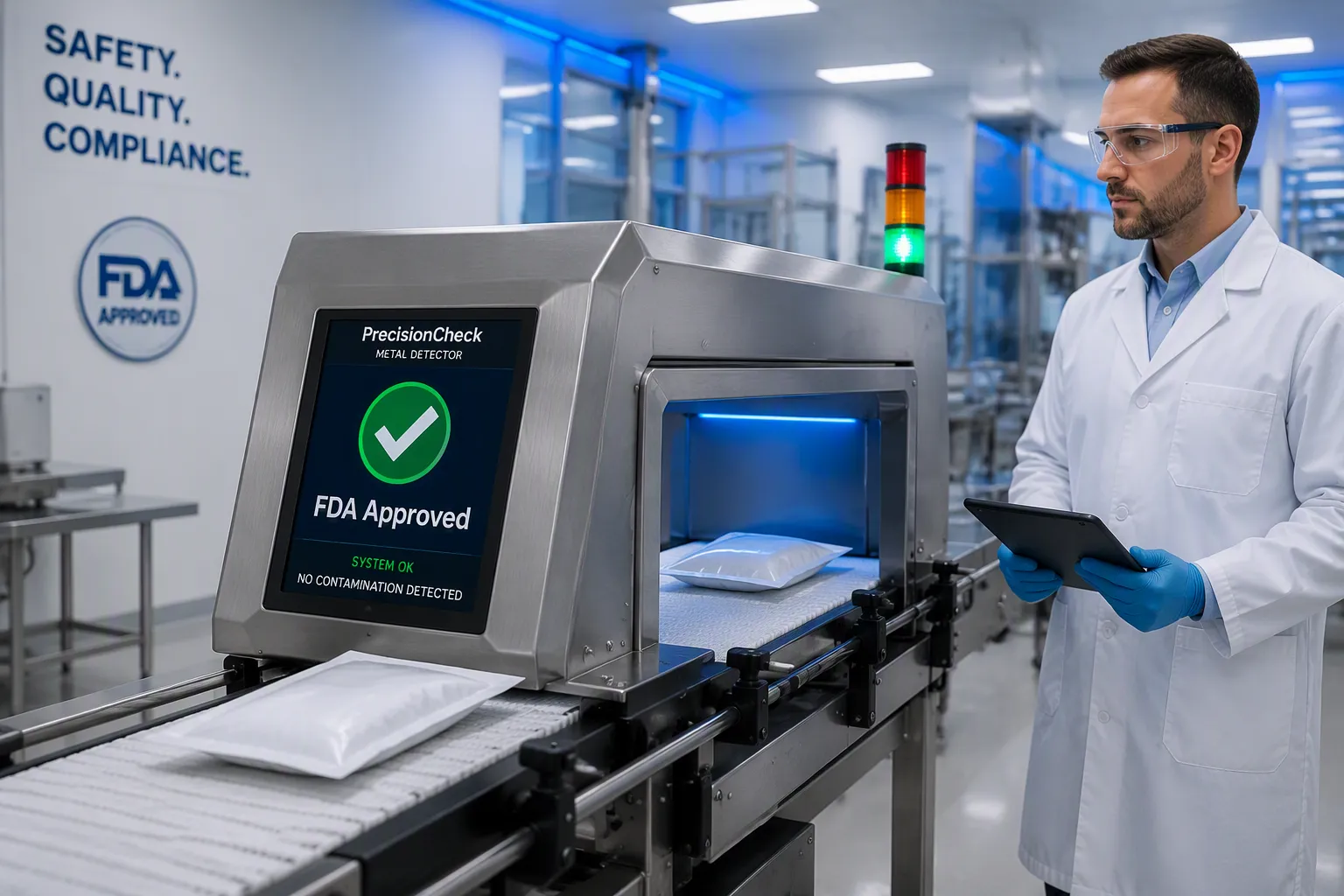
You might look for an “FDA-approved metal detector” to make your food safety plan stronger. But the agency does not approve metal detectors by themselves. Your facility must use them under FSMA as part of a proper HACCP plan. Are you sure your detection system would pass a regulatory check or a BRCGS audit? FSMA says you must treat metal contamination as a hazard if it could likely happen. The FDA Compliance Policy Guide says objects over 7mm in ready-to-eat food are considered adulteration. HACCP sets critical limits like 1.5mm ferrous, 2.0mm non-ferrous, and 2.5mm stainless steel. This guide clears up the regulatory rules, explains the difference between FDA approval and compliance, and gives a path for choosing, validating, and certifying your metal detection in food packaging. You will get clear steps to build a compliant foreign object control program.
Table of Contents
The FDA does not approve metal detectors. Instead, they require these devices to follow FSMA and HACCP rules.
Set critical limits for metal detection based on your product risk. Common limits are 1.5mm for ferrous, 2.0mm for non-ferrous, and 2.5mm for stainless steel.
Test your metal detector using calibrated test pieces in your actual product under the worst-case conditions.
Check your detector often. Test it when you start, during work, and when shifts end.
Write down every check, test, and fix you make. These records show you followed the rules during inspections.
Align with GFSI standards like BRCGS, SQF, or FSSC 22000 to go beyond the FDA's basic rules and satisfy what retailers ask for.
Train your team well and keep suppliers in check to make your foreign object control program stronger.
Don't use the same settings for everything. Set detection limits for each product and consider the environment around it.
You may look for an "fda-approved metal detector" and think it has a stamp of approval. The truth is different. The FDA does not approve metal detectors by themselves. Instead, the FDA controls them as part of your whole food safety system. This difference is important for your compliance plan and how ready you are for audits.
FDA approval is for certain drugs, medical devices, and some food additives that need review before they can be sold. FDA compliance means your facility follows the right food safety rules and good manufacturing practices. The FDA does not approve food facilities or equipment. Your facility signs up with the FDA, but that does not mean the FDA says it is good. For food processing equipment, there is no approval process. Your equipment must follow FDA rules, and you may need to show documents like IQ/OQ/PQ.
The FDA makes the rules for how you deal with physical hazards where you make food. Metal, glass, and stones are on the FDA's list of physical hazards in food rules. The FDA uses "Action Level" standards for unwanted material that does not cause health problems. These standards help the FDA decide if it should take action on a product. The FDA also says that quality control must lower these defects as much as possible.
The Food Safety Modernization Act (FSMA) changed your job from reacting to problems to stopping them before they happen. FSMA says you must put in place preventive controls for hazards that are likely to happen. Metal contamination is one of these hazards for most food processing. The FDA gave draft guidance to help you create and follow preventive control rules. You must write a food safety plan, do a hazard analysis, put in place preventive controls, and set up monitoring steps.
The FDA's Health Hazard Evaluation Board gives clear guidance on metal pieces. Metal pieces from 0.3 inch to 1 inch (7mm to 25mm) are not okay if found in any products. This number gives you a clear point to use when you set your critical limits.
Hazard Analysis and Critical Control Points (HACCP) is the base of your food safety program. You find where metal contamination could enter your process, then set a haccp critical control point there. Your HACCP plan defines critical limits for your metal detection system. These limits might say 1.5mm for ferrous metals, 2.0mm for non-ferrous metals, and 2.5mm for stainless steel. Your plan must include monitoring steps, corrective actions, and verification activities. The FDA expects you to write down everything fully.
When you look at metal detection equipment, you need to understand what compliance really means. Your metal detector must make an electromagnetic field and study changes caused by metal objects passing through. The system must find very small metal pieces, sometimes less than a millimeter, to meet pharmaceutical safety standards. Your equipment must tell apart ferrous, non-ferrous, and stainless steel because each one changes the electromagnetic field differently. You must place detectors in key spots—after mixing, during packaging—to catch contaminants before the product leaves.
Your metal detector's materials matter for compliance. Look for equipment made with full AISI 316L stainless steel. This grade resists rust and can handle tough washdown areas. A fully digital system with numerical digital processing works better than analog systems. Automatic antenna balance with dynamic balance tracking keeps operation steady. A continuous AUTOTEST function compares real-time data to factory acceptance test references. An AUTO-QC function automates alarm and ejector checks. A multi-point auto-learn system optimizes sensitivity for your specific products.
These design features give real performance gains. Modern systems show more than 50% improvement in detecting metal volume sensitivity. They store up to 1,000,000 events with data integrity checks. They support communication protocols including EtherNetIP, Profinet, Profibus, Ethercat, ModBus/TCP, and Profinet-OPC-UA.
Your metal detection system makes electronic records that must meet FDA rules. 21 CFR Part 11 covers data integrity and traceability for electronic records. Your system should give user authorization that only allows certain people to access it. This meets Part 11's need to limit system access. An audit trail automatically records parameter history, operation history, statistical data, and performance accuracy check results. This ensures you can get records back during the whole time you must keep them. Data output with encryption sends inspection records and device parameters to USB flash drives in encrypted form. Special decryption software lets you manage them safely on a computer. These steps address the rule's focus on record integrity and authenticity.
Your metal detection compliance needs go beyond the device itself. You must add the equipment to your HACCP plan, validate its performance, and check ongoing operation. The FDA expects you to keep documents that show your system works as it should. These documents are very important during inspections and third-party audits.
A balanced coil system uses three coils. One coil sends out a radio frequency signal. Two receiver coils sit on either side. These receiver coils are wired in opposite directions. When no metal enters the opening, their signals cancel out. This creates a balanced state. When metal contamination enters, it breaks this balance. The electronics boost the difference. If the signal goes past your set limit, the system triggers a reject. The center of the opening is the least sensitive spot on your detector.
Your detector must handle three types of metal contaminants. Each type acts differently in the electromagnetic field.
Metal Type | Magnetic Property | Conductivity | Detection Difficulty |
|---|---|---|---|
Ferrous | Magnetic | Conductive | Easily detected |
Non-ferrous | Non-magnetic | Good/excellent conductor | Relatively easily detected |
Stainless steel | Usually non-magnetic | Poor conductor | Most difficult to detect |
Ferrous metals give off a strong signal. Non-ferrous metals create a moderate signal. Stainless steel is the hardest to catch. Your system needs higher sensitivity settings for stainless steel. This helps you set realistic critical limits in your HACCP plan.
Many factors affect performance. Product traits play a big role. Foods with high moisture, salt, or fat content create a "product effect." This effect hides smaller contaminants. Temperature and density matter too. Packaging with metal detectable labels can help you find contamination sources. Other materials with magnetic effects lower sensitivity. Environmental conditions like temperature swings can hurt performance. The shape and position of contaminants also matter. A wire may go unseen in one position while a sphere is easy to find. Regular testing with calibrated test pieces helps you check system performance.
Set sensitivity standards that match your products. The standard measure is the diameter of a metal sphere your detector can catch at the opening center. Different opening sizes give different results.
Aperture Size | Ferrous (mm) | Non-ferrous (mm) | Stainless (mm) |
|---|---|---|---|
Small (60 x 60 mm) | 0.8–1.5 | 1.2–2.5 | 1.5–3.0 |
Medium (200 x 100 mm) | 1.5–2.5 | 2.5–4.0 | 3.5–5.0 |
Large (400 x 300 mm) | 2.5–4.0 | 4.0–6.0 | 5.0–8.0 |
Setting sensitivity involves a trade-off. Higher sensitivity catches smaller metal pieces. But it increases false rejects. False rejects lower throughput and raise costs. Best practice is to use the highest sensitivity that keeps false rejects within an acceptable limit. For products with strong product effect, use multi-frequency metal detection technology. Apply established food safety testing methods to validate your system.
You can choose from three main types of industrial metal detectors. Each matches a different product form.
Type | Description | Example Applications |
|---|---|---|
Gravity | Free-fall detectors for dry, free-flowing products | Powders, grains, cereals |
Pipeline | Detectors for liquid, paste, or soft meat pumped through pipes | Sauces, soft meats, slurries |
Conveyor | Belt-based detectors for packaged or unpackaged products | Meats, cheeses, frozen foods, bags |
Conveyor systems are the most common choice for metal detection in food packaging. They handle both packaged and unpackaged items. Manufacturers offer modular systems you can customize for your line.
Pair your detector with an automated rejection system. This integration keeps line speed and safety. Place detectors at critical control points after cutting, filling, or sealing stages. Your rejection system should remove contaminated products without stopping the line. Testing your rejection system regularly ensures it works correctly.
Synchronize your detector with other equipment. Use communication protocols like Ethernet/IP or Profinet. Good software supports traceability and audits. Choose detectors with intelligent signal processing. Regular maintenance of belt alignment is essential. A well-specified detector reduces recalls.
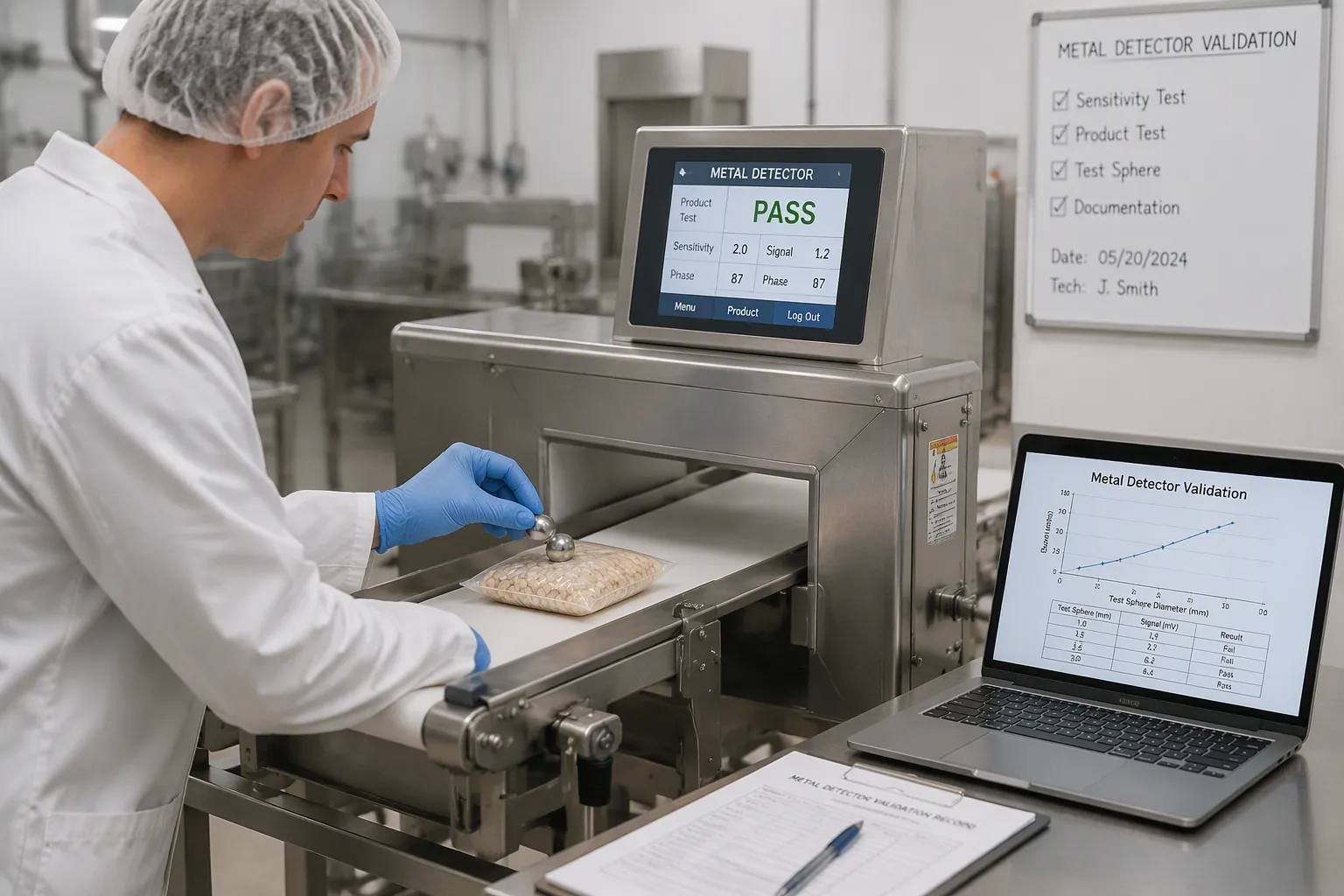
Validation and verification are the base of your metal detection program. These two steps prove your system works and keep it working. The FDA does not say a specific metal size for every product. Your critical limits must come from your HACCP plan and your product risk. This difference matters. You set the standards. You prove they work. You write down everything.
Validation happens when you first install your detector or change your product line. You prove the equipment catches metal at your set limits. This process creates the proof you need for audits and inspections.
Your critical limits depend on your product, not one number for all. Standard limits often start at 1.5mm for ferrous, 2.0mm for non-ferrous, and 2.5mm for stainless steel. But these numbers change based on your product type. Wet products, dry powders, frozen items, and metal packaging all affect detector performance. Your opening size also matters. A bigger opening lowers sensitivity.
You must check your limits during setup. Run test pieces through the detector in your actual product under worst-case conditions. Use warm, wet product in your largest pack size. This shows what your system truly catches. Retailer rules from BRC or big stores may ask for tighter limits than normal. Check your customer needs before you set your numbers.
Your detector's best sensitivity rarely works in production. Product differences cause false rejects. Set limits that catch contaminants without stopping your line too often. Remember that metal detection is not a perfect control. Use it with other prevention steps like machine checks, knife controls, and supplier checks.
Challenge testing uses calibrated test pieces to prove your detector works. Use certified test pieces for ferrous, non-ferrous, and stainless steel. Never use random scraps or nails. These uneven pieces give bad results.
Place the test piece in the least sensitive area of the opening. That spot is the center, best in the middle of your product. If the detector catches the piece at the center, it will catch it anywhere else. Run acceptance validation after setup at full line speed. Test many ways: center, off-center, top, bottom, and buried in product.
Your validation records prove your system meets your HACCP critical control point needs. Write down your hazard analysis and why you placed the detector. Record your set sensitivity standards by product type. Note the test pieces you used and the results you got. Store these records safely. The FDA expects you to show this paperwork during inspections. Your validation records also support your FSMA preventive controls.
Verification confirms your system still works after validation. You do routine checks at set times. These checks catch problems before they become recalls.
Your verification schedule depends on your risk assessment and how much product you can recheck. Think about how much product you must recheck if a failure happens. Your monitoring frequency should balance safety with what works.
Do verification tests at the start of a product run or shift change. Test whenever you change settings. Use automation with interlocks to stop the line on failure. This automation stops contaminated product from reaching customers.
When a verification check fails, act right away. Stop production right away. Separate all product that passed through the detector since the last good check. Rerun that product through a working metal detector to check its safety. Write down every action you take. Corrective actions not written down count as not done.
Your HACCP plan should say what to do for a failed verification. The plan should say to rework all product from the last good check until you found the error. Find the root cause to see why the detector failed. Fix the issue before you start production again. Set trending limits that trigger recalibration before a total failure happens.
Your paperwork ties your whole program together. Without records, your compliance efforts stay hidden from auditors.
Write a Standard Operating Procedure for your metal detection system. Include your critical limits for each product. Describe your testing steps and test piece choice. Define your verification schedule. Explain your corrective actions for failures. Give tasks to certain roles. Review this SOP regularly with your operators. Train staff on the importance of trending data. Your SOP becomes your training guide and your audit reference.
Keep detailed logs of every calibration and maintenance activity. Write down the date, time, and person who did the work. Note any adjustments you made. Track performance accuracy check results. Your system should store up to 1,000,000 events with data integrity checks. Use encrypted data output for USB drives to meet 21 CFR Part 11 rules. Safe handling and lockable reject bins for rejected product show your commitment to safety. These logs show auditors that your equipment gets steady care. They also help you spot trends before they become problems.
Your validation and verification program turns your metal detection in food packaging from a simple machine into a documented safety system. Equipment suppliers can guide you on test piece selection and validation steps. Their help lets you build a program that meets FDA expectations and third-party certification needs.
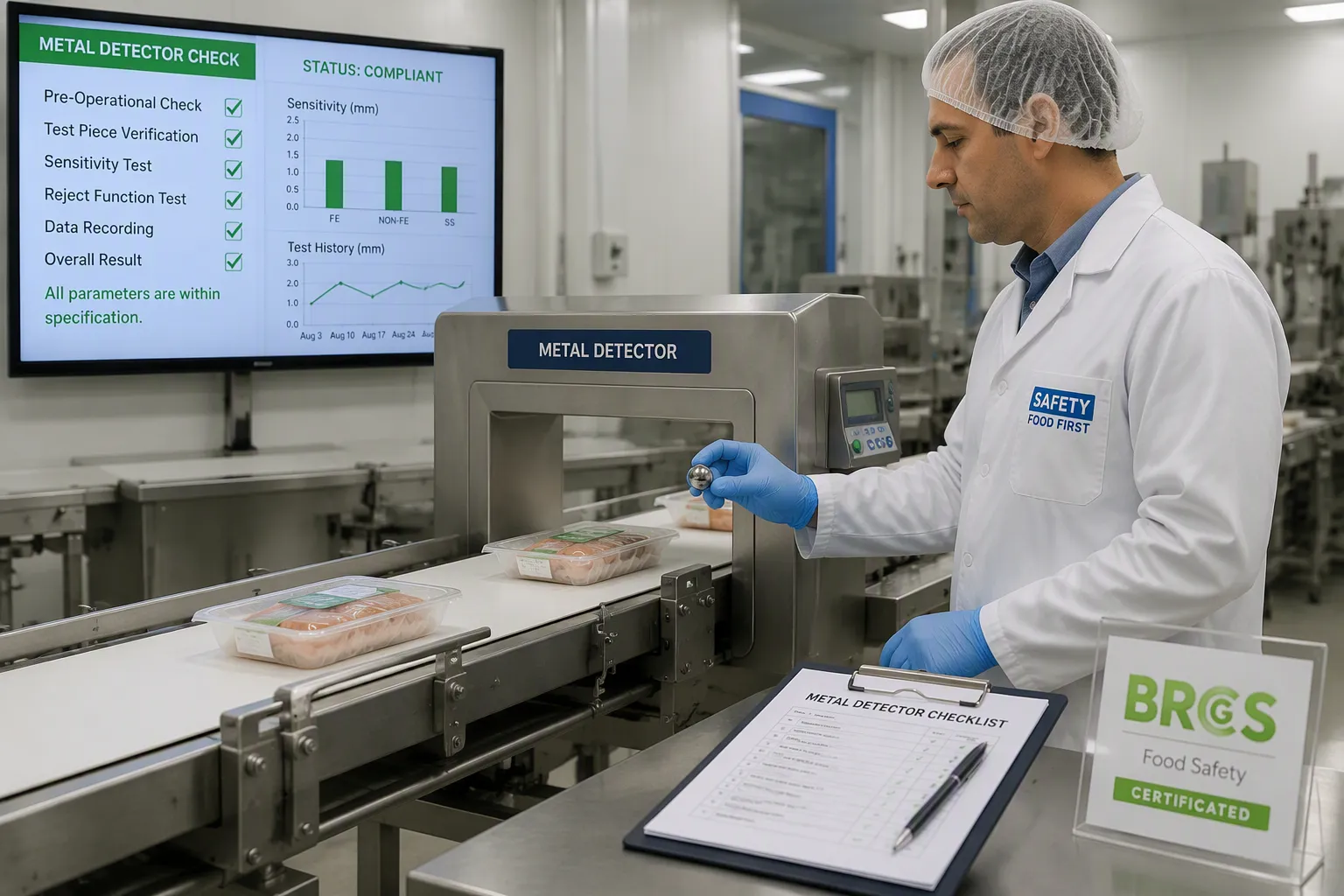
You now have a metal detector that works and is proven. The next step is making it meet third-party food safety certification standards. These certifications go beyond basic FDA rules. They ask for more frequent checks, better record-keeping, and a stronger focus on safety. Meeting them makes your program better and helps you sell to big retailers and global markets.
GFSI-benchmarked schemes like BRCGS, SQF, and FSSC 22000 set the global standard for food safety. They require you to validate and routinely verify your detection equipment. Your metal detector must support these standards with clear records and defined procedures.
GFSI-benchmarked schemes like BRCGS, SQF, and FSSC 22000 require you to validate and routinely verify your detection equipment. They set expectations for verification frequency, documentation, and validation that are more rigorous than FDA baseline. Your metal detector must support these standards with clear records and defined procedures.
The FDA does not set a specific verification frequency or minimum detection limits. GFSI standards do. They require you to test more often, document more thoroughly, and validate more rigorously. This extra scrutiny builds greater confidence in your foreign body contamination controls. It also helps you meet retailer requirements that often go beyond FDA expectations.
A strong program starts with risk assessment and ends with trained staff. You must place detectors where they matter most and ensure everyone knows their role.
Your risk assessment should map every point where metal contaminants could enter your process. Use this map to place detectors strategically at critical control points.
Standardize test piece sizes and verification frequency across all lines. Document all test results, false reject thresholds, and corrective actions. Secure and monitor the reject bin with reconciliation steps to prevent rejected product from re-entering production. Recognize that metal detectors cannot detect non-metallic foreign bodies. When risk assessment includes non-metallic foreign bodies, consider other inspection technologies.
Your equipment is only as good as the people who run it. Modern metal detection systems should be intuitive enough that a new operator can learn the basics in one short training session and run the checkpoint confidently from day one. Complexity creates inconsistency—when staff are not confident with the equipment, errors happen under pressure.
Training efficiency principle: Modern metal detection systems should be intuitive enough that a new operator can learn the basics in one short training session and run the checkpoint confidently from day one. Complexity creates inconsistency—when staff are not confident with the equipment, errors happen under pressure.
Train all operators, personnel, and even maintenance and cleaning staff on safe handling and detection principles. Training must cover standard testing procedures, data recording, processing of contaminated products, corrective actions for failed tests, critical limits per product, and general documentation. Save and catalog all training records for audit review. Maintenance personnel must perform thorough tests before and after repairs to measure detector performance changes and document results.
Managing supplier compliance is equally important. Require your raw material suppliers to certify their own metal detection controls. Audit their programs periodically. This layered approach reduces the risk of foreign body contamination entering your facility.
Even well-designed programs fail when you overlook common mistakes. Here are three pitfalls to avoid.
Do not assume one detection limit works for every product. Wet products, dry powders, and frozen items behave differently in the electromagnetic field. Your validation must account for product effect. Set critical limits per product, not per detector. Test each product at its worst-case condition. This approach minimizes false rejects while maintaining safety.
Temperature swings, humidity, and vibration can degrade detector performance. Place your equipment in a stable environment. Perform routine hygiene and mechanical checks. Monitor false reject rates as an early warning sign. A rising false reject rate may indicate a developing problem before a full failure occurs.
Your program is not static. New products, new equipment, and new regulations require updates. Review your HACCP plan annually. Revalidate after any change to your product, packaging, or line configuration. Consult with certification bodies and equipment manufacturers to ensure alignment. This ongoing review keeps your program effective and your audits smooth.
You now understand that no magic "fda-approved metal detector" exists. Your path forward involves integrating a validated, verified, and documented program into your food safety culture. You have learned the regulatory framework under HACCP and FSMA, mastered the technology, and aligned with third-party certification standards. This journey builds consumer trust and protects your brand.
Under FSMA, food manufacturers must implement preventive controls to minimize contamination risk. Metal detectors should catch metals at critical limits such as 1.5mm for ferrous, 2.0mm for non-ferrous, and 2.5mm for stainless steel, depending on metal type and product.
Conduct a gap analysis of your current program using the steps in this guide. Consult equipment manufacturers and certification bodies to stay on track. The path demands effort, but it remains a manageable investment. Your goal extends beyond passing audits—you ensure the safety of every product leaving your facility.
No. The FDA does not approve metal detectors as standalone devices. Your facility must use them under FSMA within a proper HACCP plan. Compliance means meeting 21 CFR Part 11 for electronic records and following good manufacturing practices. Your detector becomes part of your documented food safety system.
Your critical limits depend on your product risk, not one universal number. Common starting points are 1.5mm ferrous, 2.0mm non-ferrous, and 2.5mm stainless steel. Wet products and larger apertures reduce sensitivity. You must validate your limits with calibrated test pieces in your actual product.
Your testing frequency depends on your risk assessment. Consider how much product you must recheck if a failure occurs. Your monitoring frequency should balance safety with what works.
Stop production immediately. Separate all product that passed through the detector since the last good check. Rerun that product through a working detector. Document every action you take. Find the root cause before restarting. Your HACCP plan should define these corrective actions clearly.
Retailers and global markets often require third-party food safety certification that exceeds FDA baseline requirements. Certification builds buyer confidence and opens new market opportunities.
Validation proves your system catches metal at your set limits during initial setup. Verification confirms your system still works through routine checks. You validate once per product or line change. You verify continuously during production. Both processes require complete documentation for audits.
No. Wet products, dry powders, and frozen items behave differently in the electromagnetic field. Each product creates a unique "product effect" that affects sensitivity. You must set critical limits per product and test each one at its worst-case condition. Multi-frequency detectors help manage challenging products.
Place detectors at critical control points identified in your risk assessment. Your HACCP plan maps these points. Each location serves a specific purpose in catching contaminants before products ship.

