 +86 15814116500




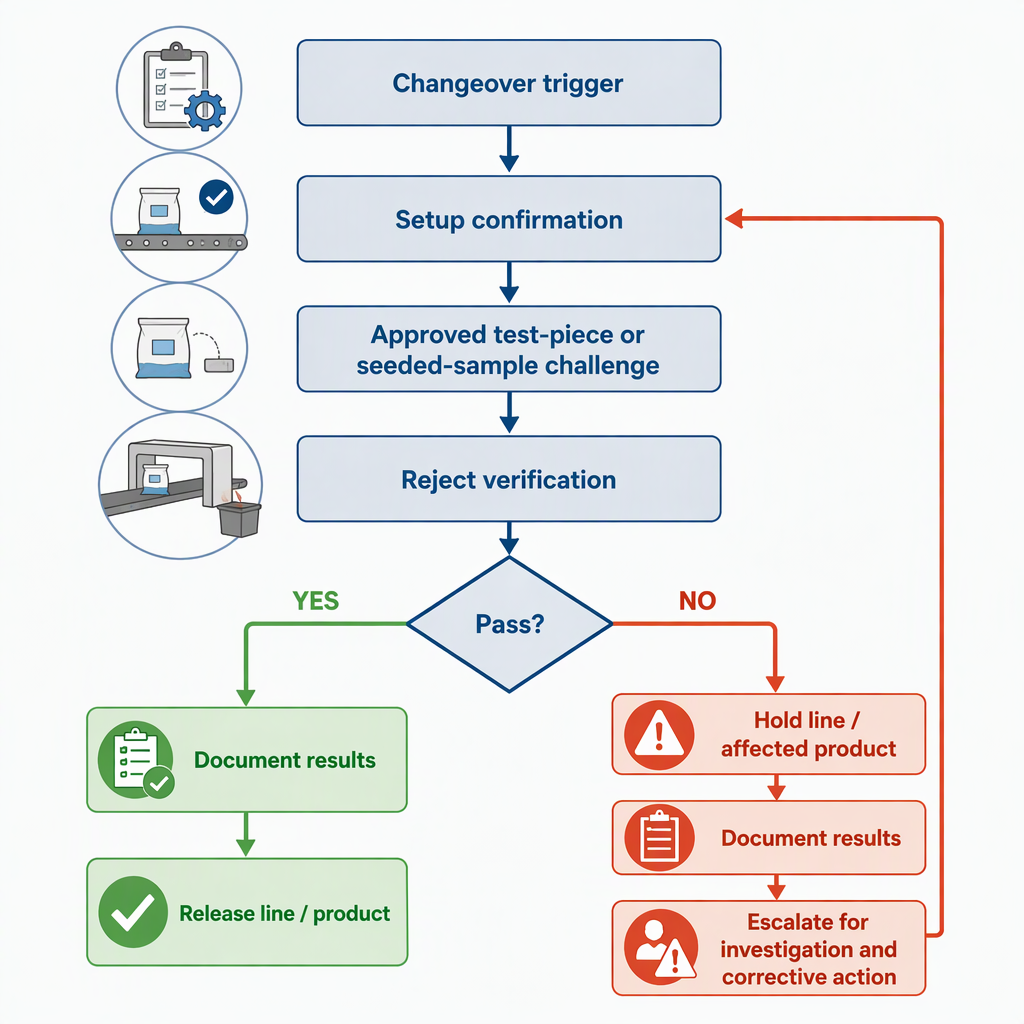
After any metal detector product changeover, treat the check as a release gate: confirm the changed product and pack setup, run approved test pieces or seeded samples through the detection zone, prove the reject action works, document results, and hold product if the check fails.

Define the changeover test scope before releasing the line
The immediate post-changeover test should confirm the detector setup, challenge the detection function, confirm the reject function, and document that the changed product can be released under the plant’s approved procedure.
For quality, production engineering, and purchasing teams, the key is not only whether a detector alarms once. The test has to prove that the new product, pack, and line condition still match the approved control method before routine production continues.
- Confirm the product identity, lot, recipe, package format, and intended detector program before starting the test.
- Use the plant’s approved test pieces, seeded samples, or validated standard for the product category and customer requirement.
- Run the test through the normal product path, not only near the detector head or at an off-line position.
- Confirm that the alarm, reject action, reject container, and line response match the written procedure.
- Record the result, reviewer, time, corrective action if needed, and final release decision.
Build the verification table around what changed
Your verification table should list every change that can affect detection, rejection, or records: formula, product condition, temperature, packaging, package size, belt speed, detector program, and reject setup.
FSIS foreign-material guidance for meat and poultry treats detection equipment, monitoring, verification, corrective actions, and procedure justification as part of the control discussion, which is why a changeover table should connect line conditions to the actual check performed.
| Changeover variable | What to confirm | Why it matters for release |
|---|---|---|
| Formula or ingredient change | Use the approved detector program and challenge method for the new product. | Different products may need site-specific validation before the same setup is accepted. |
| Moisture, salt, or product effect | Check whether the plant’s validated sensitivity or program remains applicable. | Do not assume the previous product’s response represents the new product. |
| Product temperature | Test under the temperature condition used for routine production release. | Temperature changes can be part of the product condition that must be controlled by the site procedure. |
| Packaging material | Record film, tray, pouch, foil-related components, or label changes that affect the approved setup. | Packaging changes can require a different validation or customer approval path. |
| Package size or orientation | Challenge the detector using the normal pack size and presentation through the aperture. | The check should represent the actual product path at release. |
| Reject configuration | Confirm the reject device, bin, lock, sensor, alarm, and line-stop response required by the procedure. | A detection alarm is incomplete if nonconforming product is not controlled. |
Do not copy a universal sensitivity value into the table unless it comes from your HACCP plan, customer specification, validated standard, or approved product testing. The detector supplier can support testing, but release limits must match the actual product and line.
Run the detector and reject checks in a repeatable sequence
Run the test the same way each time: confirm setup, pass the approved challenge through the product path, verify the detector response, verify the reject response, and record whether the line can restart.
USDA FSIS Directive 7310.5 describes examples that include functional metal detection, calibration to a specific standard, seeded-sample checking, monitoring, verification, corrective action, and reject evaluation in the meat and poultry context. Use those concepts as a disciplined operating model, then apply your own approved procedure and product requirements.
- Confirm the setup. Verify the detector program, product code, line speed, pack orientation, reject device, and record form before product release.
- Select the approved challenge. Use the test pieces, seeded samples, positions, and sequence defined by the facility, customer, or validated standard.
- Challenge the detector through normal flow. Pass the product or seeded sample through the detection zone as close as practical to routine production conditions.
- Verify reject control. Confirm that the rejected pack is removed from accepted product flow and handled according to the site procedure.
- Record and review. Document pass or fail, the person performing the test, the reviewer, time, product, pack, and any corrective action.
Respond to failed checks before product is released
If the detector, alarm, reject device, or record check fails, stop release, control suspect product, correct the cause under the site procedure, and repeat the approved test before restarting routine production.
A failed post-changeover check is a release decision, not only a maintenance note. Treat affected product as suspect until the plant’s quality authority decides its disposition.
- Stop routine release. Hold product made since the last acceptable check or since the changeover point defined by the procedure.
- Separate suspect product. Keep failed-test product, test packs, and rejected packs from accepted product flow.
- Escalate to quality and production leadership. Decide whether the issue is setup, product effect, reject failure, detector malfunction, or record error.
- Correct the cause. Adjust only within the approved procedure or supplier manual; do not bypass guards, defeat interlocks, or improvise detector settings outside authorization.
- Retest before release. Repeat the approved challenge and reject confirmation after correction.
If clearing a jam, retrieving a pack from a guarded area, or manually accessing a conveyor, reject mechanism, or detector enclosure is required, switch off and disconnect the applicable electrical, pneumatic, hydraulic, or battery power first, then follow the model manual and the site lockout procedure. Do not reach into moving or energized equipment.
Record the evidence that the new product is ready to run
A useful changeover record ties the pass or fail result to the product, pack, detector setup, test method, reject check, reviewer, and corrective action decision.
FSIS guidance discusses monitoring, verification, calibration to a specific standard, and supportable justification for detection procedures in its meat and poultry context. A food plant can reflect that discipline by making each changeover record specific enough to reconstruct what was tested and released.
- Product name, code, lot, recipe version, and allergen or label status where relevant.
- Package material, size, orientation, weight range, and line speed used for the test.
- Detector identification, program name or number, and reject device identification.
- Test-piece or seeded-sample description based on the plant’s approved requirement.
- Test sequence, number of passes, pass or fail result, and reject confirmation result.
- Operator, quality reviewer, date, time, corrective action, product hold status, and release decision.
Include reject handling in the changeover check
A changeover test is incomplete until the team proves that rejected packs are removed, secured, evaluated, and recorded according to the site’s procedure.
Reject handling matters because a functional detector alarm does not by itself prove that contaminated or suspect product cannot re-enter accepted product flow.
- Confirm the reject bin, lock, chute, gate, air blast, pusher, line stop, or alarm response required for the line.
- Check that rejected packs cannot mix with accepted product during the test.
- Label or segregate test packs and failed-check product according to the plant procedure.
- Review each reject event before clearing the product hold or restarting release.
- Document who evaluated the rejected pack and what disposition decision was made.
Use guidance as context, then verify with the actual product
Published guidance can frame foreign-material and metal-inclusion controls, but the actual post-changeover test must be validated for the product, packaging, line, and customer requirement being released.
The FDA’s Fish and Fishery Products Hazards and Controls guidance is a seafood HACCP resource and includes metal-inclusion context for that sector.
USDA FSIS Directive 7310.5 on foreign material in meat or poultry products gives regulatory-context examples involving functional detection equipment, seeded-sample checking, calibration to a standard, verification, corrective actions, reject evaluation, and documentation.
Do not treat sector-specific guidance as a universal detector setting sheet. For a new formula, temperature, pack material, or package size, confirm the test with actual product under the site’s HACCP plan, customer specification, and supplier-supported sample testing.
Conclusion: make product-changeover testing a release gate
The safest purchasing and operating rule is simple: no changed product should be released until the detector challenge, reject confirmation, records, and failed-check response all match the approved procedure.
- Build the verification table around what changed, not around a generic form.
- Use approved test pieces or seeded samples and record the actual product condition.
- Include reject handling, product hold, and corrective action in the release decision.
- Use published guidance as context, then confirm the control with actual product and line testing.
FAQs about metal detector product changeover testing
Before approving a detector or a changeover procedure, quality, engineering, and procurement teams should agree who owns the test method, acceptance criteria, records, and escalation path.
When should a food plant retest the metal detector after changeover?
Retest before releasing routine production whenever the product, formula, temperature condition, packaging, package size, detector program, reject setup, or line condition changes in a way covered by the site procedure.
Is there one universal test-piece size for every product?
No. Use the test pieces, seeded samples, or acceptance limits defined by the facility’s HACCP plan, customer requirement, validated standard, or supplier-supported product testing.
How should product effect be handled during procurement?
Ask the supplier to test with your actual product, temperature, package, and line conditions. Do not buy on a quoted sensitivity claim alone when the product effect has not been challenged.
Does a packaging change require a new verification check?
Yes, when the packaging change can affect detector response, product presentation, reject timing, or the approved record. Add the packaging variable to the changeover table.
What should happen if the detector passes but the reject device fails?
Hold release, segregate affected product, correct the reject problem under the approved procedure, and repeat the full detector and reject check before restarting routine production.
What records matter most during an audit or customer review?
Keep records that show the product and pack tested, detector setup, challenge method, reject confirmation, pass or fail result, reviewer, time, corrective action, and final release decision.
Can FDA seafood guidance be used for all food categories?
Use it as seafood hazard-control context, not as a universal metal detector procedure. Other categories need their own HACCP plan, customer requirements, and product-specific validation.

