

 +86 15814116500
 Views: 0 Author: Site Editor Publish Time: 2026-04-07 Origin: Site


Checkweighers in Food and Beverage Inspection help you keep product weights correct on your production line. When you control weight well, your products stay the same each time and you follow important industry rules. For example, weight controllers make sure every dairy container has the right amount inside. This protects your brand and helps you waste less. You also do not get in trouble for breaking rules and your customers keep trusting you. COSO Electronic gives you advanced checkweigher solutions that help you reach these goals with good technology.
Checkweighers make sure products have the right weight. This helps keep things the same and follows the rules.
These machines find items that are too heavy or too light. This stops mistakes and keeps your brand looking good.
Using checkweighers makes customers happy. Every package has the right amount, so people trust your products.
Checkweighers help stop waste by finding weight problems early. This saves money and makes work better.
COSO Electronic has checkweighers that are very accurate and fast. They are also simple to add to your production line.
It is important to check and fix checkweighers often. This keeps measurements right and things working well.
Teaching workers how to use and care for checkweighers is important. This helps them work better and keeps things moving.
In the future, checkweighers will use better technology. They will also work with other inspection tools for better quality.
Checkweighers are machines that weigh products on a conveyor belt. They work fast and check each item’s weight as it moves. If something is too heavy or too light, the machine finds it right away. You can use checkweighers in many food and drink factories. Here are some examples:
Bakery and confectionery: You make sure bread and cakes are always the same size.
Dairy and refrigerated foods: You check yogurt and cheese so labels are correct.
Frozen foods: You weigh frozen vegetables and seafood quickly when packing.
Ready meals: You check meal trays and lunch packs to meet rules.
Dry foods: You weigh rice and flour to stop overfilling.
Checkweighers help you stop mistakes and keep products the same every time. You get alarms or signals if the weight is wrong. This helps your line run well and keeps your brand safe.
Checkweighers help you keep products safe and good quality. These machines make sure every package has the right amount inside. Customers trust you when they get the same thing each time. You also follow rules and do not get fined for wrong labels. Here are ways checkweighers help you:
Ensuring accurate weighing: You pack the right amount every time.
Customer satisfaction: You keep customers happy because they get what they want.
Regulatory compliance: You follow the law and do not get in trouble.
Efficiency in production: You find mistakes fast and fix them, saving money.
Checkweighers give you quick feedback. You see problems right away and can fix them before they get big. You waste less and keep costs low.
Tip: Using checkweighers helps you follow strict rules. You keep your business safe and your products good for everyone.
Here is a table with some rules that need checkweighers:
Standard/Program | Requirement for Checkweighers |
|---|---|
BRCGS Global Food Safety Standard (BRC) | Needs checkweighers to keep food quality high. |
Safe Quality Food (SQF) Program | Says you must use checkweighers for quality and tracking. |
COSO Electronic makes advanced checkweighers for food and drink factories. The company started in Dongguan, China, and works hard to make new and better machines. You get products that fit your needs and help you work faster. COSO Electronic’s checkweighers are very accurate and quick. You can check weights from small things up to 40 kilograms. The conveyor type is easy to add to your line. You also get free spare parts and a 12-month warranty.
Here is a quick look at COSO Electronic’s checkweigher features:
Feature | Details |
|---|---|
Application Area | |
Accuracy | ±0.1 g |
Check Weight Range | 1 g–10000 kg |
Type | Conveyor Type |
After-sales Service | Free Spare Part Exchange |
Warranty | 12 Months |
You can trust COSO Electronic to help you keep products good and your line working well. The company’s slogan says it best: Make production more efficient, make products more reliable.
Checkweighers work by checking each product as it moves. The conveyor brings items to the weighing area. Sensors see each product and start weighing. Load cells measure the weight right away. The control unit checks if the weight is correct. If the weight is not right, the system takes the product off the line. The system saves all the weight data for reports and to help you improve later. This process helps your line run well. You can find problems early and fix them fast.
Infeed and Product Detection: The conveyor brings products to the scale. Sensors spot each item and begin weighing.
Weighing of the Products: Load cells check the weight as products pass by.
Comparison with the Target Weight: The control unit sees if the weight is in the set range.
Rejection of Products That Don’t Weigh Right: If a product is too heavy or too light, it gets removed.
Data Logging and Reporting: The system keeps track of all weights for reports and changes.
Checkweighers use different parts to do their job. Each part helps make sure products have the right weight.
Component | Role |
|---|---|
Conveyor Belt | Moves products to the scale without stopping. |
Load Cells | Measures each product’s weight and sends signals. |
Control Unit | Checks the weight and tells if a product should be removed. |
Rejection System | Takes away products that do not meet the weight rules. |
Load cells are sensors that check weight. When a product goes over the scale, the load cell senses its weight. It turns the weight into an electrical signal. This signal goes to the control unit. Load cells are very sensitive and give correct readings every time.
The conveyor system moves products through the checkweigher. It keeps items spaced out and steady on the scale. You can change the speed and height to fit your line. This lets you check many products quickly without stopping.
The control interface is like the brain of the checkweigher. You use it to set the weight limits. It checks each product’s weight against your settings. If a product does not match, the control interface tells the rejection system to take it away. You can also see live data and reports on the screen.
Modern checkweighers collect data as products move. The system tracks weight changes and how often products get removed. This helps you fix problems fast and make your process better. You can keep your line moving and avoid long stops.
If a product does not meet the weight rules, the checkweigher uses special devices to remove it. Here are some common ways to reject products:
Reject Mechanism | Weight Capacity | Speed (packages/minute) | Description |
|---|---|---|---|
Air Jet Reject Device | < 1 lb | Up to 250 | Blows light items off the line with air, good for fast lines. |
Bopper Reject Device | < 2.5 lbs | Up to 250 | Knocks light items off the conveyor, works fast. |
Pusher Reject Device | Up to 8 lbs | Up to 80 | Pushes heavier items off the line with a cylinder. |
Swing Gate/Diverter Reject | Up to 5 lbs | Up to 200 | Moves products that do not meet rules to the side. |
Drop Belt Conveyor Reject | < 6 lbs | Up to 100 | Drops off-target items into a bin by lowering the belt. |
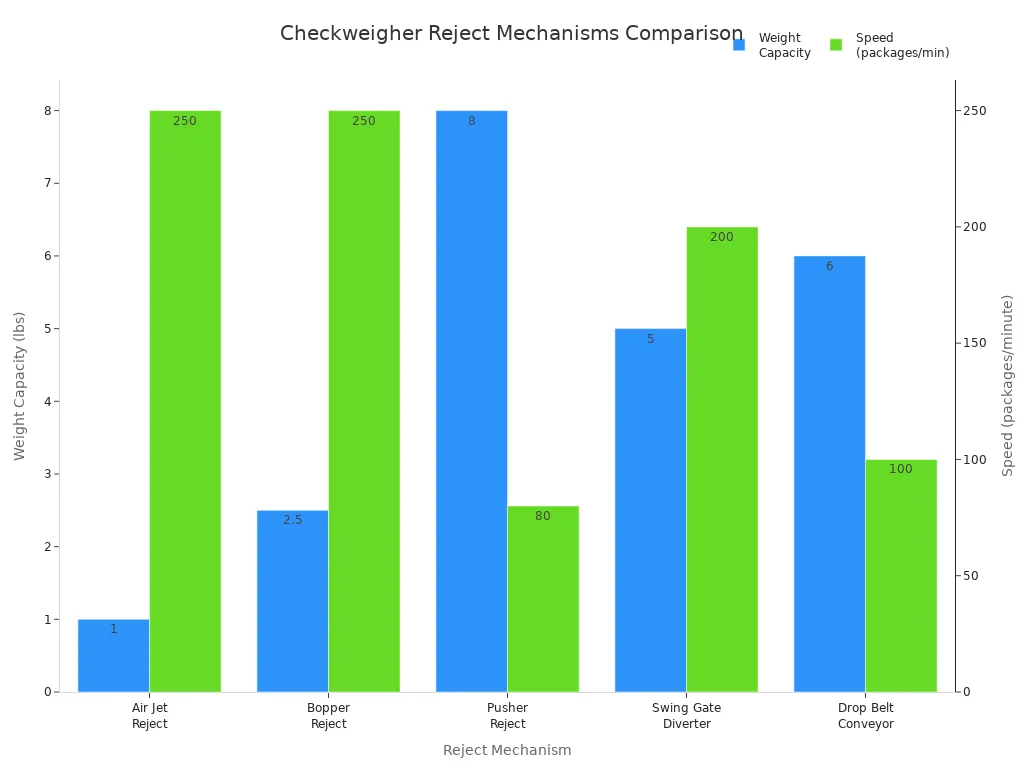
You can pick the best rejection device for your products. Air jets are good for light and quick items. Pushers and swing gates work for heavier or bigger packages. Each type helps your line stay fast and your products the right weight.
Note: Real-time data and automatic rejection help you keep quality high and waste low. You can make quick decisions and keep your customers happy.
You need your production line to run smoothly and quickly. Checkweighers help you reach this goal. They measure each product’s weight as it moves on the conveyor. Modern checkweighers can measure weight to fractions of a gram or even a milligram. This high level of accuracy is important in food and beverage production. You want every package to have the right amount inside.
Checkweighers automate the weighing process. You do not need to stop the line to check weights by hand.
They reduce bottlenecks and keep your line moving fast.
You can run your production at higher speeds without losing accuracy.
For example, in a dairy plant, a dynamic checkweigher makes sure each milk bottle is filled just right. This helps you get the most from each batch. You save time and use your resources better. Checkweighers in Food and Beverage Inspection play a big role in keeping your products consistent and your line efficient.
Tip: Accurate weighing means you do not give away extra product or risk underfilling. This protects your profits and your brand.
You must follow rules about product weight. Checkweighers help you meet these rules every day. They check each item and remove any that do not match your standards. This keeps you in line with laws and industry standards.
Compliance Standard | Description |
|---|---|
Measuring Instrument Directive (MID) | A European rule that makes sure weighing tools like checkweighers are accurate and reliable. It helps you follow EU laws for goods sold by weight or volume. |
Checkweighers are reliable tools in your production line. They work all day to keep your products safe and your customers happy. You can trust them to help you avoid fines and keep your business running smoothly. When you use checkweighers, you show your customers that you care about quality and honesty.
You want to use your materials wisely. Checkweighers help you do this by catching mistakes early. If a product is too heavy or too light, the system finds it right away. You can fix problems before they lead to big losses.
Checkweighers help you optimize your process and reduce waste by keeping weights accurate.
They catch small changes fast, so you can adjust your machines and save materials.
They stop issues like false rejects and poor fill levels, which can waste product.
When you reduce waste, you save money and help the environment. You also make your production more efficient. Using checkweighers is a smart way to keep your business strong and your products reliable.
When you pick a checkweigher from COSO Electronic, you get more than a weighing machine. You get a smart tool that helps your business do better. COSO Electronic makes checkweighers that fit what you need. You can trust these machines to keep your line working well and your products the right weight.
Here are some key advantages you get with COSO Electronic checkweighers:
High Accuracy at High Speed:
You can check every product fast and still be accurate. COSO checkweighers measure very small weights, even when your line is quick. You do not have to slow down to get good results.
Automatic Sorting and Rejection:
The system finds products that do not match your weight rules. It takes them off the line right away. You do not need to stop or check by hand. This saves time and keeps your line moving.
Flexible Integration:
You can add COSO checkweighers to almost any line. You can change the conveyor height and speed. The machines work for many products, from snacks to big boxes.
User-Friendly Operation:
The control screen is simple to use. You can set weight limits, see live data, and get reports. You do not need special training to use the system.
Hygienic and Safe Design:
COSO checkweighers use safe materials for food. You can clean the machines easily. This helps keep your factory safe and your products clean.
Expandable Quality Control:
You can use checkweighers with metal detectors or X-ray systems. This gives you more ways to check your products and keep them safe.
Tip: COSO Electronic gives you free spare parts and a 12-month warranty. You get help when you need it.
Here is a table that shows how COSO Electronic checkweighers stand out:
Feature | COSO Electronic Checkweigher | Standard Checkweigher |
|---|---|---|
Accuracy | ±0.1 g | ±20g or more |
Speed | High | Medium |
Integration | Very Flexible | Limited |
User Interface | Easy and Intuitive | Basic |
Hygiene | Food-Grade, Easy Clean | Standard |
Quality Control Options | Expandable | Fixed |
After-Sales Support | Free Parts, 12 Months | Limited |
You can see that COSO Electronic gives you more value. You get better accuracy, faster speed, and more ways to keep your products safe. You also get help when you need it.
When you use COSO Electronic checkweighers, you protect your brand. You make sure every product meets your standards. You also save money by wasting less and stopping mistakes. This helps your business stay strong and trusted by your customers.
There are two main types of checkweighers in food and beverage factories. These are static and dynamic models. Static checkweighers make you stop each product to weigh it. Dynamic checkweighers, also called inline models, weigh products as they move on the conveyor. Most new factories use dynamic checkweighers. They keep your line moving fast and cut down on hand work.
Here is a table that shows how they are different:
Feature | Static Checkweighers | Dynamic Checkweighers |
|---|---|---|
Operation Speed | Requires products to stop for measurement. | Measures weight on the fly. |
Accuracy | Typically offers higher precision. | Extremely accurate, but influenced by movement. |
Throughput | Best for small batches or sample checks. | Handles hundreds of products per minute. |
Automation and Labor | Requires manual handling and supervision. | Fully automated, reducing labor needs. |
Integration | Often standalone, not designed for inline use. | Seamlessly integrates into production lines. |
Data Management | Requires manual recording of weight data. | Offers advanced data logging and real-time analytics. |
Cost | Lower upfront cost. | Higher investment due to automation. |
Dynamic checkweighers help you keep up with fast production. You do not need to stop the line. This saves time and work. You also get live data to help you make things better.
Tip: If you want your line to be faster and make fewer mistakes, pick dynamic checkweighers.
If you need to weigh many products at once, multi-lane checkweighers are best. These systems let you check several items side by side. This is great for busy lines like snack packs or stick pouches.
Key advantages of multi-lane systems include:
You can weigh more than one product at the same time. This makes your line faster and helps you make more.
The system removes any item that does not meet your rules right away.
Live reports help you see trends and find problems quickly.
You can add these systems to your current lines without much change.
Here is a table that shows the benefits:
Advantage | Description |
|---|---|
Multi-lane efficiency | Simultaneously weigh multiple stick pouches with high precision. |
High-speed performance | Designed to keep up with the most demanding production lines. |
Reliable quality control | Automated rejection removes non-compliant pouches instantly. |
Seamless integration | Fits easily into existing filling and packaging lines. |
Data-driven accuracy | Real-time reporting and tracking to optimize operations. |
You can also stop giving away too much product and protect your profits by watching for overfill. Multi-lane systems help you stop underfills, keep labels right, and check every product—not just a few.
COSO Electronic lets you change your checkweigher to fit your needs. You can pick the best options for your products and your line. COSO gives you different touchscreen sizes and languages. You can even put your company logo on the startup screen. You can choose standard or food-safe belts. You can also pick from different rejection systems like pushers or air-blow devices.
Here is a quick look at some options:
Option | Description |
|---|---|
HMI Type | 7-inch or 10-inch touchscreen |
Operating Language | Chinese, English, and more |
Client Name & Logo | Displayed on startup |
Machine Structure | Standard or modular sections |
Rejection Bins | Custom sizes for your products |
Machine Size | Models from CW120 to CW600; custom sizes available |
Belt-to-Ground Height | Adjustable to fit your line |
Belt Material | Standard or food-grade |
Rejection System Options | Pusher, air-blow, dual-rejection, and more |
Weighing Lanes | Single or multi-lane |
WLAN Interface | USB standard; WLAN optional |
MES Integration | Online support for factory systems |
Appearance Customization | Stainless steel or powder-coated |
Other Custom Features | Bottle-specific or roller-type weighers for heavy products |
Note: COSO Electronic can give you checkweighers that fit your factory. You get a flexible and reliable solution every time.
You want your checkweigher to fit your line well. First, pick the right model for your products. Think about what you make and how fast your line goes. Check how exact you need the weighing to be. Make sure the checkweigher works with your other machines.
Put the checkweigher where you can reach it easily. Follow the maker’s steps for setting it up. Test the machine before you start making lots of products. This helps you find problems early.
Here are some good tips for setting up your checkweigher:
Think about your product type and how fast you work.
Check if the checkweigher matches your machines and accuracy needs.
Make sure there is enough space and you can get to it for repairs.
Follow all setup steps from the maker.
Test the system to see if it works right.
Use the data from the checkweigher to make your process better.
Tip: If you plan well when you set up, you will have fewer problems later. Your line will run better and smoother.
You want your checkweigher to stay correct. Calibration keeps the machine measuring right. Use special weights to check the system. Big machines may need checks more often.
Check the checkweigher every day with a quick test. Do a full calibration every three months. Focus on doing the same test, checking the reject gate, and making sure the belt moves right. Many factories do a big check once a year, but you might need to do it more or less. It depends on how much you use the machine and your factory’s rules.
Here is a simple table for how often to check and fix things:
Task | Recommended Frequency |
|---|---|
Daily Span Check | Every day |
Full Calibration | Every quarter |
Annual Calibration | Once a year |
Maintenance Check | As needed or scheduled |
Keep the checkweigher clean and free from dust. Plan for experts to check it so it does not break. Regular checks keep your machine working well and stop long breaks.
Note: Checking and fixing your checkweigher often keeps your products good and your machine working right.
You want your team to know how to use the checkweigher. Teach workers how the machine works. Show them how to set weight limits and read the numbers. Teach them what to do with rejected products. Make sure they know how to clean and take care of the checkweigher.
Give easy guides and let them practice. Tell your team to ask questions and tell you if something is wrong. Well-trained workers help you get the best from your checkweigher.
Give clear steps for using the checkweigher every day.
Teach your team how to find and fix mistakes.
Go over safety and cleaning steps.
Update training when you get new machines or change how you work.
Tip: Good training helps your team feel sure and keeps your line running well.
You want your checkweigher to work well every day. Sometimes, problems can happen on your production line. Knowing how to find and fix these issues helps you keep your line running smoothly. Here are some simple steps you can follow when your checkweigher does not work as expected:
Visual Inspection:
Start by looking at your checkweigher. Check for any visible damage, loose parts, or things blocking the conveyor. Sometimes, a small object or a piece of packaging can get stuck and cause trouble.
System Check:
Make sure all parts of the checkweigher have power. Look at the control screen and lights. If the machine does not turn on, check the power supply and switches.
Connection and Wiring:
Look at all the cables and wires. Make sure they are plugged in tightly and not broken. Loose or damaged wires can stop the checkweigher from working right.
Functional Testing:
Use a known weight to test the scale. Place the weight on the conveyor and see if the checkweigher shows the correct number. If the reading is wrong, you may need to calibrate the machine or check for dirt on the scale.
Consult Documentation:
If you still have problems, look at the manual from the manufacturer. The manual gives you special tips for your model. You can also find answers to common questions and see what to do next.
Tip: Always keep your checkweigher clean and free from dust or food bits. Regular cleaning helps prevent many problems before they start.
Here is a table with some common issues and what you can do:
Problem | What You Can Do |
|---|---|
Machine does not start | Check power and all connections |
Wrong weight readings | Test with known weight, recalibrate |
Products not moving smoothly | Inspect conveyor for blockages |
Frequent false rejects | Clean sensors and check settings |
Error messages on screen | Read manual for error code solutions |
If you follow these steps, you can solve most problems quickly. You do not need to be an expert to do basic troubleshooting. If you cannot fix the issue, contact your supplier or a technician for help. Keeping your checkweigher in good shape means your products stay accurate and your line keeps moving.
Checkweighers are used in food factories every day. Many companies use them to make sure each package is filled right. When you use checkweighers, you control your product better. Here are some ways they help food makers: You get more accurate weights. Every package matches the weight you want. This keeps your products the same each time. You follow industry rules. Accurate checks help you avoid fines and keep your brand strong. You waste less. The system finds and removes packages that do not meet your standards. Some companies saw waste drop by 15% and had fewer complaints in six months. A snack company used a COSO Electronic checkweigher to check every bag of chips. The machine found bags that were too light or too heavy. The company saved money and made customers happier.
In the pharmaceutical world, every tablet or bottle must have the right weight. Even a small mistake can make medicine unsafe or not work well. Checkweighers help you follow strict rules and keep products safe. You do not need to check each item by hand. The machine does it for you, so you save time and avoid mistakes.
A checkweigher works like an inspector on your line. It finds packages that are not complete or have open flaps. This helps you follow Good Manufacturing Practices (GMP) and other important rules.
Makers of consumer goods use checkweighers too. They check things like soap bars, batteries, or small toys. You can spot missing parts or wrong weights before products reach your customers.
COSO Electronic has helped many companies fix real problems. For example, a plastic parts maker needed to check the weight of every package. COSO gave them a checkweigher that found mistakes fast. The company met quality rules and kept customers happy. A waffle factory wanted to weigh whole waffle sheets before cutting. COSO made a special weighing section for them. This made the process more accurate and reduced waste. You can read more about these stories on the COSO Electronic website. These examples show how checkweighers in Food and Beverage Inspection help you meet industry challenges, save money, and protect your brand.
Note: When you use COSO Electronic checkweighers, you get a solution that fits your needs. You can trust your products to be right every time.
New technology is making checkweighers better every year. These machines can now weigh things very fast. You can check hundreds of items each minute without stopping your line. Dynamic checkweighers, like the ones at GULFOOD MANUFACTURING 2025, help busy factories keep up. These systems use smart software to watch weights as products move. You get instant updates and can fix problems right away. Automatic rejection takes away products that do not meet weight rules. This keeps your line running well and stops mistakes.
Dynamic checkweighers weigh food fast and keep your line moving.
High-speed machines check many products every minute.
Real-time tracking software helps you follow rules and spot trends.
Automatic rejection removes overweight and underweight products, saving money.
These new features help your products stay the same each time. You can trust your line to be quick and correct.
You can use checkweighers with other inspection tools. This gives you more ways to check your products. Metal detectors find metal pieces in powders and bulk foods. X-ray machines find objects and check fill levels in packages like ampoules and blister packs. When you use these systems together, you cover more risks.
Checkweighers keep tablet and capsule weights right.
Metal separators catch metal in powders before packing.
X-ray systems find objects and check fill levels in sealed packs.
Using these tools together gives you full quality control.
Some factories use systems that check for metal and weight at the same time. You can stop giving away too much product and keep your food safe. This helps you follow strict rules and keeps customers happy.
Note: Using inspection systems together helps you find problems early and protect your brand.
You help make your factory more green. Checkweighers help you waste less by making sure every product meets weight rules. When you do not overfill, you save materials and spend less money. You also stop underfilling, so customers are happy and you avoid recalls. More companies now want to be sustainable. You need checkweighers that help with these goals.
Checkweighers help you:
Benefit | How It Supports Sustainability |
|---|---|
Stops overweight and underweight | |
Save Materials | Uses resources wisely |
Improve Efficiency | Keeps production smooth and accurate |
Meet Regulations | Helps you follow environmental standards |
Checkweighers are not just for quality. They help you build a greener and more responsible business. In the future, you will see even smarter systems that help you reach your green goals.
Tip: Using advanced checkweighers helps you protect the planet and your profits.
You help make sure your products are safe and always the same. Checkweighers in Food and Beverage Inspection help you reach quality goals and work faster.
"Inspection and detection systems are very important for making sure quality plans work well," says Multivac’s Dunovic.
If you pick COSO Electronic, you get good machines that help you do better.
You throw away less.
You follow the rules.
You keep your brand strong.
"Customers of Fortress Technology really want metal detectors that work well and do not reject good products by mistake," says Eric Garr.
You can count on COSO Electronic to help your line do well.
Checkweighers are used in many factories. You see them in food, beverage, and pharmaceutical plants. They are also in chemical, cosmetic, electronics, and consumer goods factories. These machines help control product weight. They make sure products meet quality rules in different production lines.
Checkweighers check every product by themselves. You do not have to stop your line or weigh things by hand. This keeps your line moving fast. You can find mistakes early and fix them quickly.
Yes, you can add a checkweigher to most conveyor lines. COSO Electronic checkweighers let you change the height and speed. They have flexible connections. You can fit them into your line without much trouble.
You should test calibration every day with a test weight. Do a full calibration every three months. This keeps your machine correct. Your products will stay within the right weight range.
The checkweigher takes away products that are too heavy or too light. It uses pusher or air blow rejection mechanism to remove these items. This way, only good products go to your customers.
Yes! COSO Electronic checkweighers work well on fast lines. You can check hundreds of products each minute. You do not lose accuracy or slow down your line.
COSO Electronic gives you free spare parts and a 12-month warranty. You can get help from their team for setup, fixing problems, or maintenance.

