

 +86 15814116500
 Views: 0 Author: Site Editor Publish Time: 2025-10-23 Origin: Site


Are you confused about the difference between a checkweigher and a scale? While both measure weight, they serve distinct roles in industries.
In this article, we will explore the key differences between checkweighers and scales. You'll learn when each is used and which one fits your specific needs best.
Checkweighers are specifically built for high-speed environments where continuous weighing of moving products is essential. These devices can weigh items at rates up to 120 per minute, making them indispensable in automated production lines. For instance, industries like food packaging and pharmaceuticals rely on checkweighers to ensure product weights are consistently within the specified range.
In contrast, traditional scales are designed for static weighing. Items are manually placed on the platform, and the scale displays the weight. Scales operate at a much slower pace compared to checkweighers and are ideal for low-volume tasks where speed is not a priority, such as in retail or laboratory environments.
The difference in speed significantly affects production workflows. Checkweighers can seamlessly integrate into fast-paced environments, improving overall efficiency. Scales, on the other hand, require manual input and take more time for each measurement, which limits their use in high-throughput applications.
Tip: If you're in an industry with high production volumes, investing in checkweighers can significantly enhance your throughput and minimize labor costs.
Checkweighers excel at providing highly accurate measurements, with some models offering precision up to 0.1g. This level of accuracy is vital in industries where strict weight regulations must be followed, such as in food manufacturing or pharmaceutical production. Checkweighers are designed to detect even the slightest deviations in product weight, helping to maintain product consistency and compliance.
Scales typically provide a lower level of accuracy, with most standard models offering precision around 0.5g. While this accuracy is sufficient for most non-industrial uses, it may not meet the stringent requirements of industries that demand precise weight control. Scales are better suited for ad-hoc, manual weighing tasks rather than continuous, high-precision applications.
The accuracy of checkweighers plays a crucial role in quality control and regulatory compliance. In industries like food and pharmaceuticals, ensuring that each product meets its specified weight is not only a matter of quality but also a legal requirement. Scales, while accurate for general use, are less suited for these high-precision demands.
Consider upgrading to a checkweigher if your products require high accuracy and frequent quality checks, especially in regulated industries.
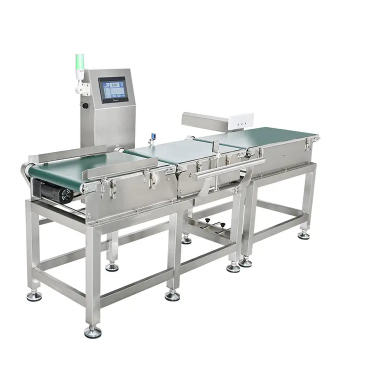
Checkweighers are designed for integration into automated production lines. These systems automatically weigh products as they move along a conveyor, ensuring that products are within the desired weight range. If an item is found to be overweight or underweight, the system can reject it automatically without any manual intervention, which reduces the risk of errors.
On the other hand, scales are usually standalone devices and are not integrated into automated production systems. They require manual intervention, and operators need to place items on the scale for weighing. This makes them unsuitable for high-speed, continuous production environments, where automation is key to maintaining efficiency.
By integrating checkweighers into production lines, manufacturers can streamline their operations. The automated nature of checkweighers helps reduce labor costs and minimize human error, leading to a more efficient and consistent production process. In contrast, scales can create bottlenecks in workflows due to their manual operation.
One of the standout features of checkweighers is their ability to record and track weight data over time. This data can be used for statistical process control (SPC) to monitor trends and identify potential issues before they affect production. The real-time feedback provided by checkweighers allows manufacturers to adjust processes immediately, improving product consistency and reducing waste.
Scales generally lack the capability to record data continuously. While some digital scales may log individual measurements, they do not provide the level of integration and real-time data analysis that checkweighers offer. This limits their ability to contribute to long-term process improvement.
Checkweighers play a vital role in maintaining product quality through statistical process control. By continuously recording data and providing actionable insights, checkweighers allow businesses to refine their processes and maintain high standards. Scales, on the other hand, do not offer this level of data analysis.
Annotation: For businesses that rely on long-term process improvement, checkweighers provide the tools to manage data effectively, while scales only offer limited measurement tracking.
Checkweighers are a significant investment, both in terms of initial purchase price and ongoing operational costs. These systems are more complex than scales and require specialized installation, maintenance, and calibration. However, their speed, accuracy, and integration into automated lines can offer a substantial return on investment over time.
Scales are relatively inexpensive, especially when compared to checkweighers. They are easy to use and maintain, making them ideal for small businesses or industries where high-volume weighing is not required. However, scales lack the advanced features of checkweighers and are not suitable for high-speed production lines.
While checkweighers may require a higher initial investment, their ability to automate processes, increase speed, and reduce human error can lead to substantial cost savings in the long term. The ability to track and manage production data also contributes to improved operational efficiency, making checkweighers a valuable asset for businesses with high production demands.
Tip: If your production volume justifies the expense, the return on investment from a checkweigher will outweigh the initial costs through efficiency gains and reduced labor.
In conclusion, while checkweighers and scales both serve the essential function of measuring weight, they differ significantly in their capabilities, applications, and advantages. Checkweighers are designed for high-speed, automated production environments, offering superior accuracy, integration, and data logging capabilities. Scales, while simpler and more affordable, are better suited for low-volume, manual weighing tasks.
Choosing between a checkweigher and a scale depends largely on the specific needs of your production process. If you require high accuracy, automation, and integration, a checkweigher is the best choice. However, for smaller-scale operations or applications where speed is not a priority, a scale may suffice. COSO ELECTRONIC TECH provides a wide range of checkweighers that offer outstanding value with their high-speed, accurate, and automated features, perfectly suited for industrial and production environments.
A: A checkweigher is an automated device used to weigh products on a production line, ensuring they meet specified weight requirements for quality control.
A: While both measure weight, a checkweigher is designed for high-speed, continuous weighing in production, whereas a scale is typically used for static, manual measurements.
A: A checkweigher offers higher accuracy, automation, and real-time data logging, making it ideal for fast-paced, high-volume production lines.

